

The Hmong story cloth: Preserving history with needle and thread

Hmong Story Cloth: Preserving history
Story cloths are one of several types of Hmong needlework and fabric arts known as paj ntaub, or "flower cloth." It’s an art form that’s been a part of the Hmong culture for centuries. Paj ntaub is most often found on traditional Hmong clothing, but can be found on traditional Hmong clothing, blankets, baby carriers and other home décor.
MINNEAPOLIS (FOX 9) - Story cloths are one of several types of Hmong needlework and fabric arts known as paj ntaub, or "flower cloth." It’s an art form that’s been a part of the Hmong culture for centuries.
Paj ntaub is most often found on traditional Hmong clothing, but can be found on blankets, baby carriers and other home décor.
Story cloths are a recent addition to Hmong textile art
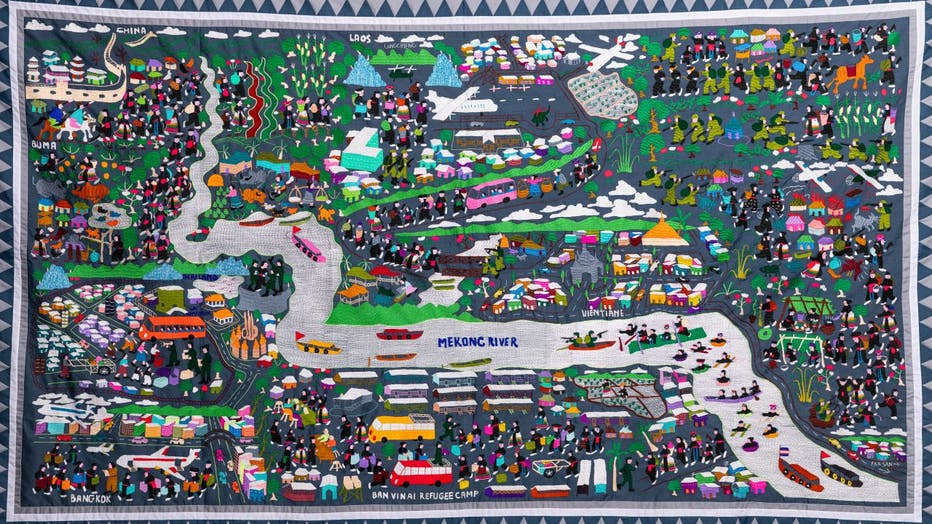
Hmong story cloths are a relatively new addition. The first ones can be traced to the mid-1970s when the Hmong started arriving in refugee camps in Thailand. Typically, Hmong men would draw the images onto a piece of cotton cloth and the women would then do the embroidery.
The story cloths were used to depict everyday life, wildlife, folk tales and Hmong history.
Dig deeper:
A common theme for story cloths is the journey of the Hmong. Some begin with their time in China, while others start during the 1960s and 1970s when the Hmong were recruited by the CIA to fight in the Secret War.
Here's a closer look at a story cloth used to depict the Hmong's journey from Loas to the United States.
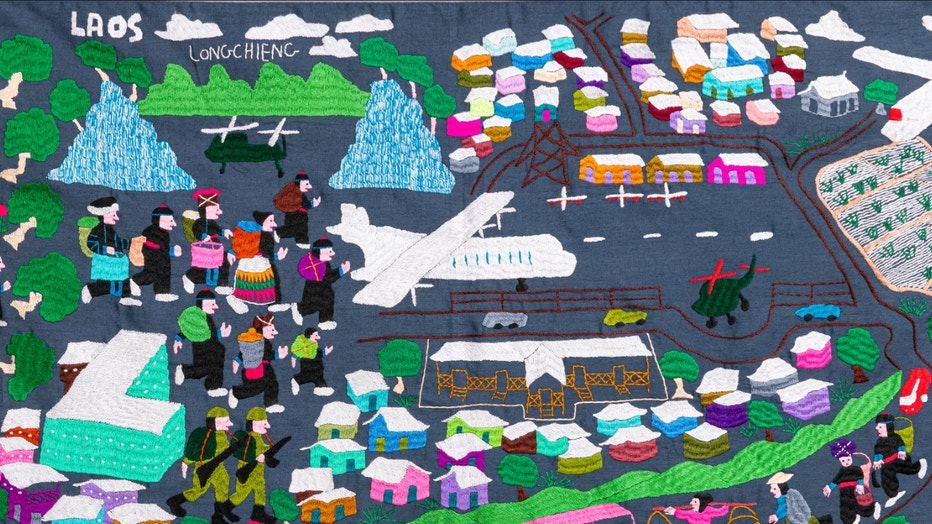
Long Cheng was the military base for the Hmong Army during the Secret War.
Long Cheng was the military base for the Hmong Army during the Secret War. The CIA also operated an airbase out of Long Cheng. It has been called the "Most Secret Place on Earth." At its peak, Long Cheng had a population of 40,000 and was one of the busiest airports in the world. The military base fell to communist forces on May 14, 1975.
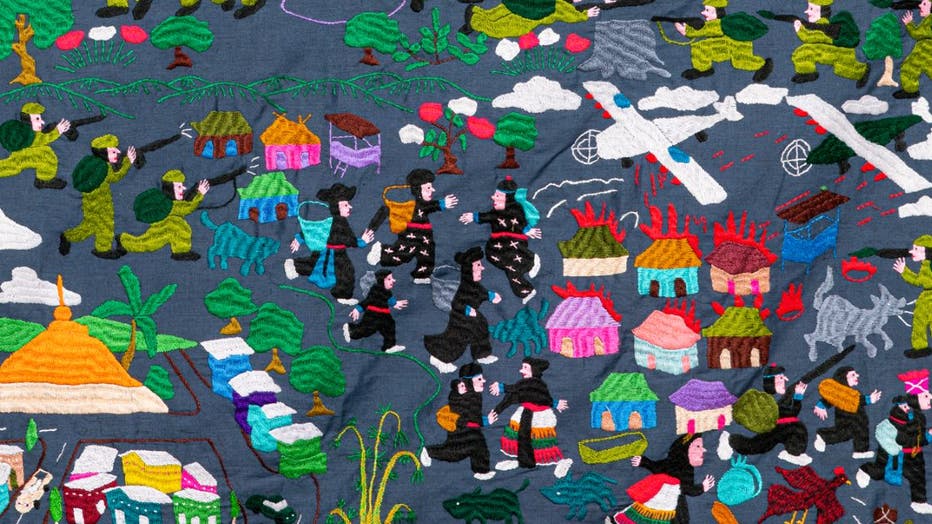
After the U.S. withdrew its support from Laos, the Hmong were persecuted for their role in the Secret War. According to the University of Central Arkansas, an estimated 100,000 Hmong people died as a result of Laotian policies after 1975.
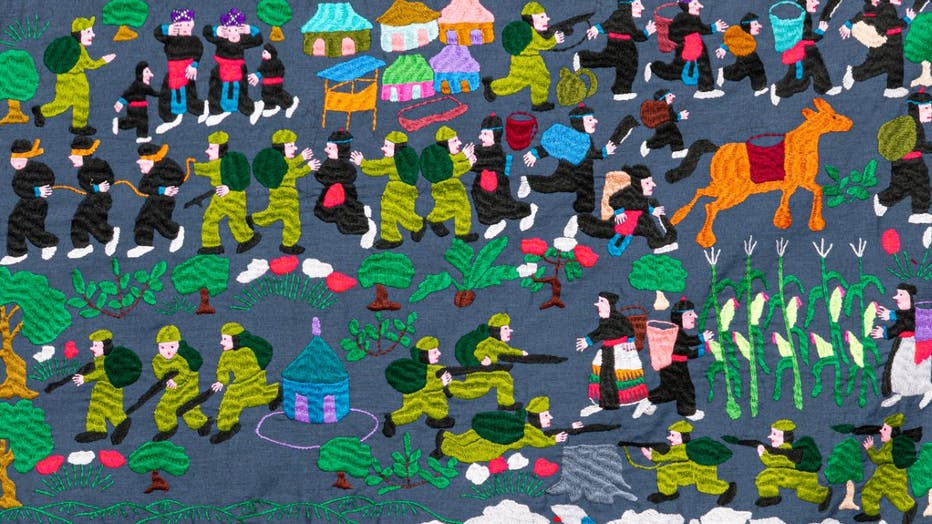
Many Hmong were captured by communist soldiers and sent to re-education or concentration camps, where they starved or were worked to death.

Other Hmong people made the perilous trek south to Thailand, often traveling at night through the jungle to avoid communist soldiers. Some parents gave their babies opium to keep them quiet so their cries wouldn’t alert the enemy.
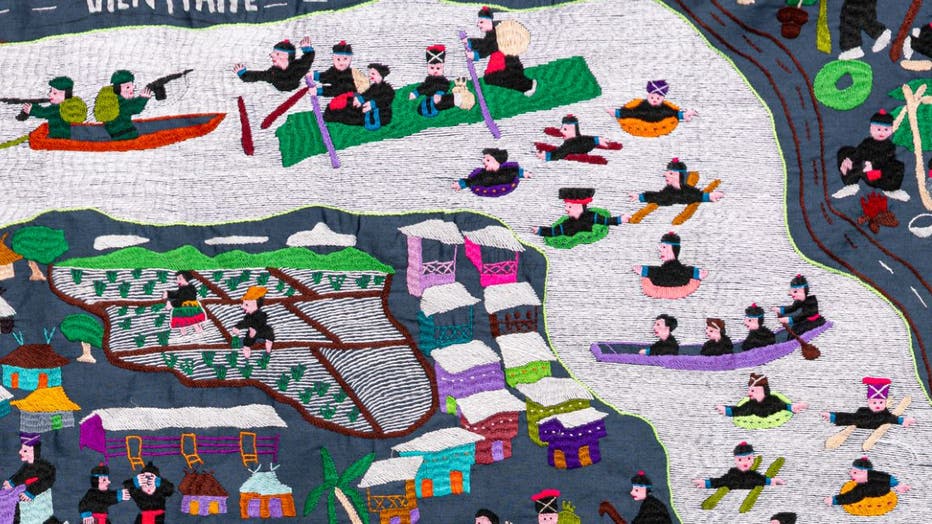
Crossing the Mekong River.
The Mekong River forms a significant part of the Laos-Thailand border and the Hmong were forced to cross the river to get to refugee camps in Thailand. Another added danger: communist soldiers patrolled the banks of the river and would shoot anyone they saw trying to cross. Some used improvised flotation devices like plastic bags to help them swim across the Mekong. Others cut down lengths of bamboo and placed one under each arm to keep them afloat. Not everyone made it across. It is believed more than 50,000 Hmong people died trying to cross the Mekong River.

Ban Vinai Refugee Camp.
Those who made it across the Mekong River found their way to refugee camps in Thailand. Ban Vinai was the largest. There refugee camps were where the Hmong lived as they waited for resettlement opportunities.
According to Stanford University, approximately 138,000 Hmong escaped to refugee camps in Thailand between 1975 and 1997.
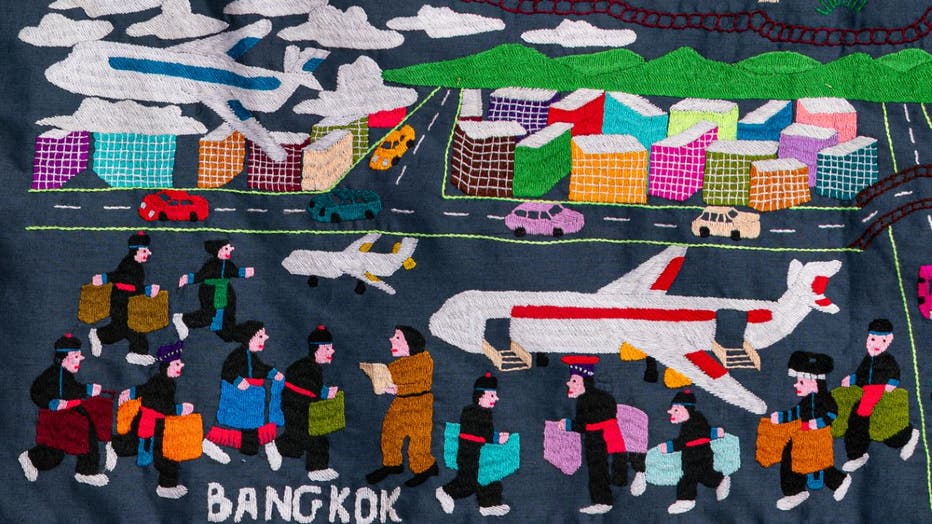
The majority of Hmong refugees resettled in the United States, but several other countries welcomed them in. They include Australia, Canada, France, Germany and French Guiana.
'Hmong in Minnesota: 50 Years of Resilience' documentary
Watch:
A new FOX 9 documentary "Hmong in Minnesota: 50 Years of Resilience" dives into the journey of Hmong refugees in America 50 years after the fall of Vietnam. Interviews and historical footage illustrate the success of Hmong families as well as the cultural challenges they faced as they resettled in Minnesota. Hmong Americans in Minnesota, spanning multiple generations, also share their hopes for the next 50 years.
"Hmong in Minnesota: 50 Years of Resilience" premieres at 7:30 p.m. on Dec. 24 on FOX 9+ and streaming on FOX LOCAL and FOX9.com. You can watch the documentary on-demand on FOX LOCAL, FOX LOCAL Mobile, YouTube and FOX9.com.