

The last time the Insurrection Act was used

ICE protests: Minneapolis chief on shooting
Days after the fatal shooting of Renee Good by a federal ICE agent, protests continue across Minneapolis. The city's Police Chief Brian O'Hara joined LiveNOW's Josh Breslow to talk about the shooting and the protest.
President Donald Trump has threatened to invoke the Insurrection Act and send the U.S. military to Minnesota as anti-ICE protesters continue to clash with federal agents.
Trump wouldn’t be the first president to invoke the Insurrection Act, but experts say he’d be the first to use the law to quell unrest that began because of federal officers the president has already deployed. One of those officers, Jonathan Ross, shot and killed a U.S. citizen during an immigration crackdown Jan. 7.
Here’s a breakdown of the law and how it’s been used.
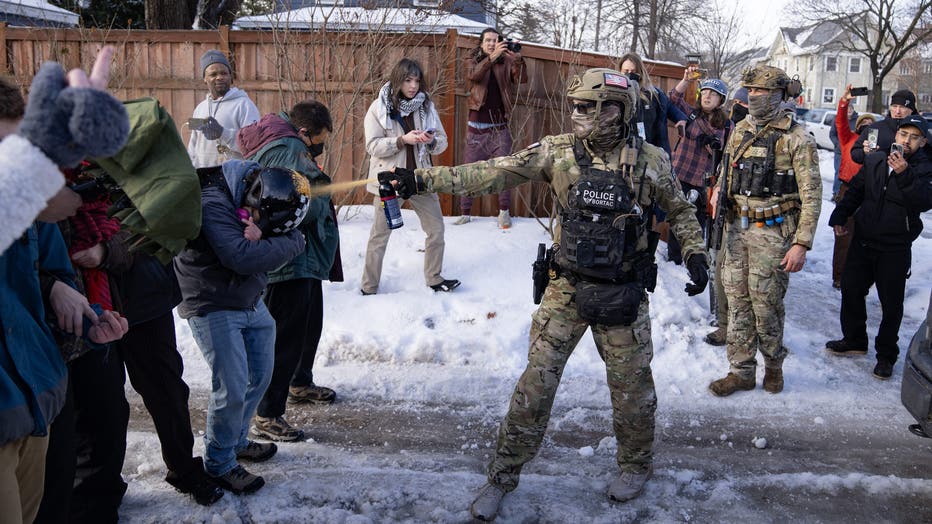
A Border Patrol Tactical Unit agent sprays pepper spray into the face of a protestor in Minneapolis, Minn. on Wednesday, January 7, 2026. (Photo by Alex Kormann/The Minnesota Star Tribune via Getty Images)
What is the Insurrection Act?
The backstory:
The Insurrection Act allows the president to dispatch active duty military in states that are unable to put down an insurrection or are defying federal law.
Congress passed the act in 1792, just four years after the Constitution was ratified.
READ MORE: Minneapolis ICE shootings: Trump threatens to institute Insurrection Act
George Washington signed the first version, which authorized the president to use state militias when "laws of the United States shall be opposed, or the execution thereof obstructed."
He and John Adams used it to quash citizen uprisings against taxes, including liquor levies and property taxes that were seen as essential to the young republic’s survival.
Congress expanded the law in 1807, restating presidential authority to counter "insurrection or obstruction" of laws. Experts say the early statutes recognized a fundamental "tradition against military intervention in civilian affairs" except "as a tool of last resort."
The Insurrection Act is typically used to respond to widespread violence that has broken out on the local level — and usually after local authorities ask for help. When presidents acted without local requests, it was typically because citizens were being threatened or not protected by state and local governments, like the Civil Rights movement. A third scenario is an outright insurrection — like the Confederacy during the Civil War.
Why is Trump threatening the Insurrection Act?
Big picture view:
Trump’s threat was in response to protests that began after Ross, an ICE agent, killed 37-year-old Renee Good during an immigration operation in Minneapolis.
The protests continued after a federal officer shot a man in the leg in north Minneapolis a week later. Federal officials claim the officer was attacked while attempting to arrest the man from Venezuela. Protesters in the area clashed with federal agents, throwing fireworks and rocks at officers. Federal agents used chemical irritants on protesters.

Minneapolis officials give update on ICE-involved shooting
Minneapolis Mayor Jacob Frey and Minneapolis Chief of Police Brian O'Hara spoke Wednesday night on the latest ICE-involved shooting in the city.
What they're saying:
In a post on Truth Social Thursday, Trump posted:
READ MORE: One year in: Poll reveals how Americans feel about Trump's return to White House
"If the corrupt politicians of Minnesota don't obey the law and stop the professional agitators and insurrectionists from attacking the Patriots of ICE, who are only trying to do their job, I will institute the Insurrection Act, which many presidents have done before me, and quickly put an end to the travesty that is taking place in that once great state. Thank you for you (sic) attention to this matter! President DJT."
The other side:
Constitutional law experts say it would be unprecedented for Trump to invoke the Insurrection Act in Minnesota because "none of the criteria have been met."
"This would be a flagrant abuse of the Insurrection Act in a way that we’ve never seen," Joseph Nunn, an attorney at the Brennan Center for Justice’s Liberty and National Security Program, told The Associated Press.
Still, Minnesota officials would have "a tough argument to win" in court, experts say, "because the courts are typically going to defer to the president" on his military decisions.
When was the Insurrection Act used the last time?
Timeline:
Presidents have invoked the law 40 times, some of those done multiple times for the same crisis.
Lyndon Johnson invoked it three times — in Baltimore, Chicago and Washington — in response to the unrest in cities after the assassination of Dr. Martin Luther King Jr. in 1968.
MORE: The Insurrection Act: What is it and could Trump invoke it for National Guard?
The last time the Insurrection Act was used was in Los Angeles in 1992 to quell riots linked to the police beating of Rodney King. A jury failed to convict four white police officers of excessive use of force despite video showing them beating King, a Black man. California Gov. Pete Wilson asked President George H.W. Bush for support.
Bush authorized about 4,000 troops — but after he had publicly expressed displeasure over the trial verdict. He promised to "restore order" yet directed the Justice Department to open a civil rights investigation, and two of the L.A. officers were later convicted in federal court.
The Source: This article includes information from FOX 9 Minneapolis, President Donald Trump’s Truth Social Account, The Associated Press and previous FOX Local reporting. FOX’s Megan Ziegler contributed.