

Pres. Trump issues new 15% global tariff despite Supreme Court ruling: Is it legal?
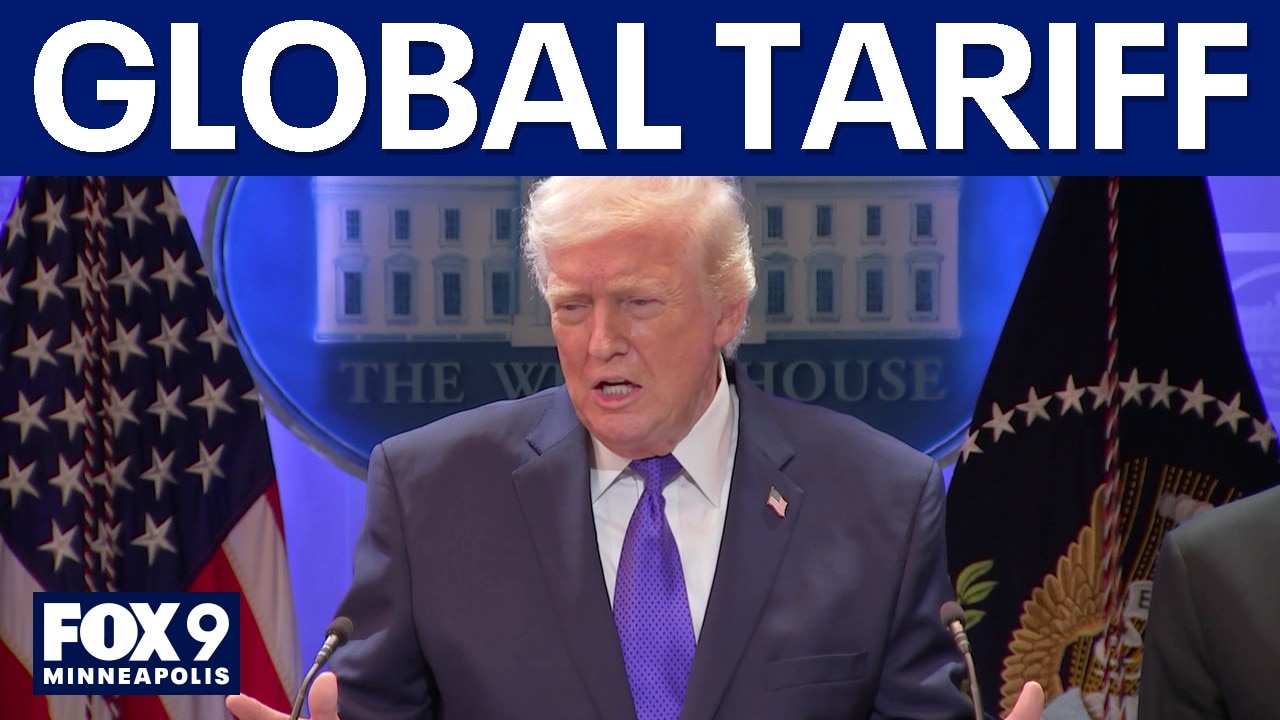
Pres. Trump issues new global tariff: Is it legal?
Hamline law professor David Schultz weighs in on the recent Supreme Court ruling on tariffs and President Trump's response by issuing a global tariff.
(FOX 9) - Following a Supreme Court decision striking down his tariffs, President Trump announced new global tariffs under a never-used before provision in a 1974 trade law. Hamline law professor David Schultz walked us through the recent decision and what might be next.
New tariffs issued after Supreme Court decision
What we know:
President Trump announced a 10% tariff on products from all countries, which he later announced he would increase to 15% on Saturday. This move comes after the Supreme Court ruled that only Congress can impose tariffs, raising questions about the president's authority.
Dig deeper:
President Trump said he was issuing the tariffs under section 122 of the Trade Act of 1974. That section gives the president the power to impose tariffs of up to 15% for up to 150 days to respond to remedy "international payment problems." The provision specifically lists issues like "large and serious United States balance-of-payment deficits," preventing the "imminent and significant" depreciation of the dollar in foreign exchange markets, and correcting balance-of-payment disequilibrium.
This is the first time a president has ever enacted this provision in the trade law.
Legal expert weights in
What they're saying:
David Schultz, a law professor at Hamline University, joined FOX 9 Morning News on Sunday to discuss the latest ruling and Trump's latest round of tariffs.
Supreme Court ruling explained
"The main point of the decision on Friday was to say that the Constitution clearly says that the power to set tariffs resides with Congress, not with the President of the United States, and it said that the president lacked the authority to be able to impose tariffs without congressional authorization," Schultz explained. "The president's again claiming he has ability to be able to do this. I suspect what we're going to see is this tariff winds up in court again and be challenged again because it's just not clear, based upon both the ruling on Friday and what the Constitution says he has the authority to be able to do this. And so we may be back to square one in terms of yet another round of challenges."
Confusion in the marketplace
As Schultz explained, the president's ability to impose these tariffs is likely to be challenged again in the courts. But, the biggest issue might be the confusion surrounding the recent decision and the new tariff.
"It throws more confusion into world trade yet again in terms of the fact that you're asking these questions," explained Schultz. "We've got people around the world asking these questions. But I think one of the most important things we're missing here, in terms of what the ruling said, is how this changes the bargaining game, both domestically and globally. Having trimmed back his authority to do tariffs, a lot of other countries, let's say even Canada to the north of us, maybe looking at this, saying, these new tariffs might be declared unconstitutional. They may be able to wait it out with the president. And then, domestically, what we're going to start to see is a lot of corporations starting to say, ‘Hey, we paid in all this money in tariffs, we want our money back.’ And I suspect we're going to see a lot more lawsuits being filed, even domestically in this country, challenging his authority or asking for the money back."