

New survey reveals age range most likely to drive after cannabis use
New survey reveals age range most likely to drive after cannabis use
New Minnesota data is starting to show who is getting behind the wheel after using cannabis and why the state is still trying to measure the risk. FOX 9's Corin Hoggard has the story.
(FOX 9) - New Minnesota data is starting to show who is getting behind the wheel after using cannabis and why the state is still trying to measure the risk.
Survey data shows who is driving after using cannabis
What we know:
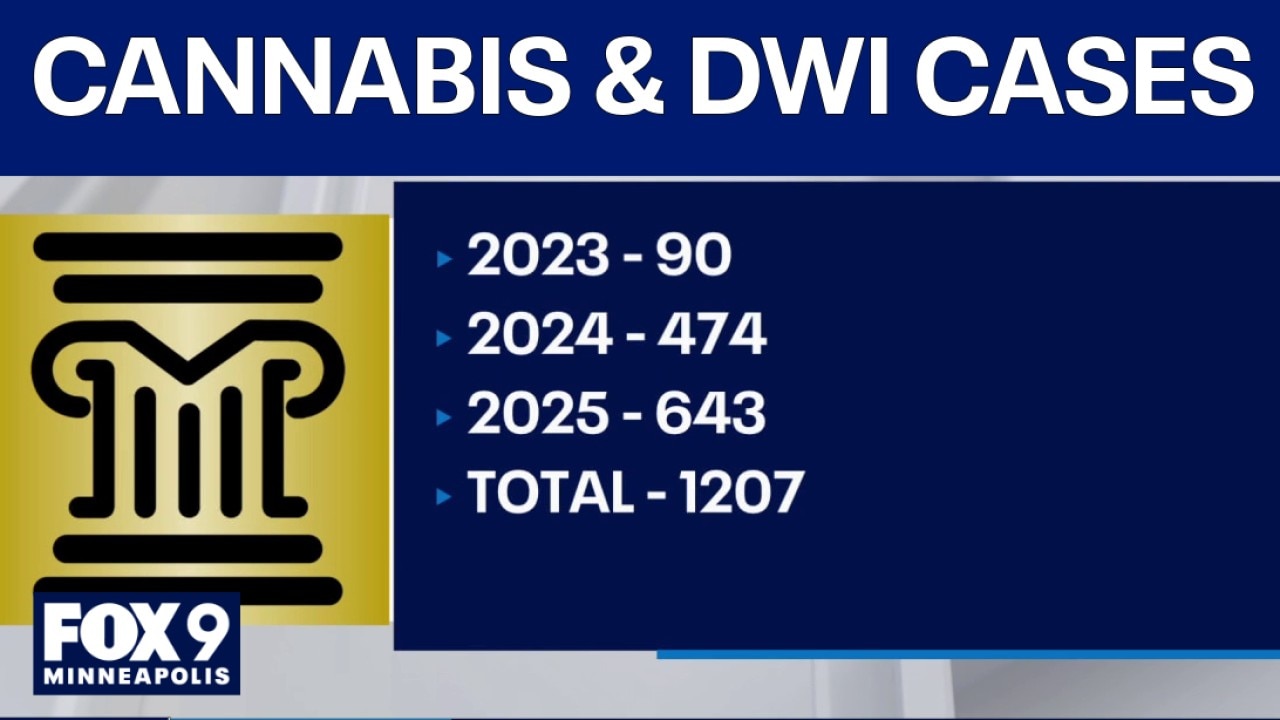
Cases are still uncommon but climbing: Prosecutors across Minnesota filed only 1,207 cannabis impaired-driving cases between 2023 and 2025.
State officials say those cases are still uncommon, but the numbers are going up.
Mike Hanson, Minnesota Office of Traffic Safety director, said, "there are people who are making potentially deadly decisions before they get behind the wheel."
Surveys point to younger users:
The University of Minnesota Cannabis Research Center conducted surveys at the state fair and some county fairs in 2024 and 2025.
Those surveys found about one in six cannabis users, or 15.7%, admitted to using while they were driving or just before.
People ages 18 to 20 cannot use cannabis legally, but the surveys showed they were the most likely group to drive after using.
Colin Planalp of the University of Minnesota Cannabis Research Center said, "They are also more likely to discount risk, so they are less likely to believe that they are running a serious risk by driving and using cannabis simultaneously."
A rural-urban split also showed up in the findings.
People in the Twin Cities Metro were less likely to use cannabis and drive than people in rural communities.
Hanson said, "The biggest reason that I hear it is because they can get away with it. They think that because there are fewer law enforcement resources out there."
Why cannabis impaired driving is harder to prove
Dig deeper:
Research on how legalization affects impaired driving is still in its early stages, and in some states the number of fatal crashes actually fell.
Hanson said, "Last year we had a pretty significant decline in crashes too, okay, but our cannabis market wasn't fully developed, and so you can't really look at that."
Researchers at the center say it is still cloudy whether driving drunk or driving high is worse, but it is pretty clear a driver using cannabis is more dangerous than a driver who is not.
They say reaction time gets noticeably slower, and Planalp said, "People will take someone who has used cannabis, put them in a driving simulator, and see that their driving has become demonstrably worse."
Field-testing is the next big question.
Proving cannabis impairment is not as clear-cut as alcohol.
Planalp said, "I think part of that is simply because it has been much easier to study alcohol in the United States for many years."
There is no field-test as accurate as a breathalyzer because people all process cannabis differently, and the speed of intoxication varies based on how it is consumed.
Hanson plans to ask lawmakers to let officers use a saliva test in the field, and a positive result would clear the way for a warrant to collect blood or urine, which are more accurate.
Hanson also said Minnesota has now trained about 400 drug recognition experts whose observations are allowed in court, saying, "So for anybody out there that thinks ‘I can get away with it because the cops can't figure out what I'm using’, you're wrong and you will wind up in the backseat of a squad car in handcuffs."
What we don't know:
Researchers are still in the early stages of figuring out how marijuana legalization is affecting impaired driving in Minnesota.
It is also not yet clear how a fully developed cannabis market will affect crash numbers, or whether lawmakers will approve Hanson’s proposal for field saliva testing.
The Source: This story uses information from the University of Minnesota Cannabis Research Center and interviews by FOX 9's Corin Hoggard with the research center and the state Office of Traffic Safety.