

Instacart ending price test program after backlash
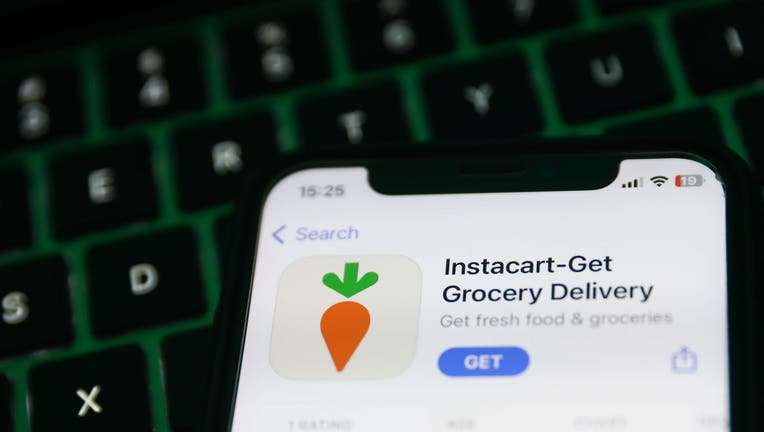
FILE - A laptop keyboard and Instacart on App Store displayed on a phone screen are seen in this illustration photo. (Jakub Porzycki/ NurPhoto via Getty Images)
Instacart is ending a program where customers saw different prices for the same product ordered at the same time from the same store.
Here’s what they’re saying about the price testing strategy:
Instacart price testing
The backstory:
Earlier this month, a report from Consumer Reports and two advocacy groups said they found in an experiment that Instacart offered nearly three out of every four grocery items to shoppers at multiple prices.
For example:
The experiment by Consumer Reports and the two progressive advocacy groups found that Instacart customers saw one of five different prices for the same dozen of Lucerne eggs from a Safeway store in Washington, D.C.: $3.99, $4.28, $4.59, $4.69, or $4.79.
What they're saying:
Instacart offered context last week, clarifying its prices were not the result of dynamic pricing or surveillance pricing – and were never based on supply or demand, personal data, demographics or individual shopping behavior. The company said it was due to short-term, randomized A/B testing.
"A/B testing … is common in the grocery industry and across the entire retail sector. It’s a way for retailers to test how sensitive consumers — at a macro level — are to the price of certain items," Instacart said.
"Maybe dropping the price of a box of cereal could lead to an increase in sales. Maybe the same drop in price on a bag of frozen vegetables results in less of a change. These insights can help retailers understand where to invest in lower prices — for all customers."
Dig deeper:
Instacart also added that it does not control prices on its platform, and that retail partners set their own pricing strategies on Instacart.
"While we encourage them not to, some (retailers) choose to apply markups to help cover the costs of implementing our technology and offering same-day delivery," Instacart added.
Instacart ending price testing
Big picture view:
Instacart announced Monday it would be ending price testing on its platform, which has been available to retailers since 2023.
What they're saying:
"We understand that the tests we ran with a small number of retail partners that resulted in different prices for the same item at the same store missed the mark for some customers," the company wrote.
"At a time when families are working exceptionally hard to stretch every grocery dollar, those tests raised concerns, leaving some people questioning the prices they see on Instacart. That’s not okay – especially for a company built on trust, transparency, and affordability."
The other side:
The program was meant to help grocers and other retailers learn more about what kinds of prices customers would pay for items, similar to how stores offer different prices for the same products at different locations.
RELATED: FTC accuses Instacart of hidden fees; company to pay $60M in refunds
Instacart settlement
Meanwhile:
Last week, in a separate case, Instacart agreed to pay $60 million in customer refunds to settle federal allegations of deceptive practices.
What they're saying:
The Federal Trade Commission had accused Instacart of falsely advertising free deliveries and not clearly disclosing service fees, which add as much as 15% to an order and must be paid for customers.
Instacart denied FTC allegations of wrongdoing and said it reached a settlement in order to move forward and focus on its business.
The Source: Information in this article was taken from two Instacart blog posts, from Dec. 18 and Dec. 22, 2025, on its price testing, and from a Consumer Reports experiment. Background information was taken from The Associated Press. This story was reported from Detroit.