

Air quality alert issued for Twin Cities, central Minnesota due to high ozone levels
![Minnesota air quality forecast for summer 2026 [FULL]](https://static-media.fox.com/fmcv3/prod/fts/xkybwsvzz5fjal9v/08tapeyzg1kdhf9l.jpg)
Minnesota air quality forecast for summer 2026 [FULL]
The Minnesota Pollution Control Agency held a press conference to announce the state's air quality outlook for summer 2026. Meteorologists predict this summer could bring more air quality alerts, with wildfire smoke and ozone expected to impact several days.
MINNEAPOLIS (FOX 9) - An air quality alert has been issued for the Twin Cities metro and parts of central Minnesota on Tuesday as elevated ozone levels are expected to make the air unhealthy for some residents.
Air quality alert in Twin Cities
The backstory:
The Minnesota Pollution Control Agency (MPCA) says the alert is in effect from noon until 9 p.m. Tuesday and covers the Twin Cities metro area, St. Cloud, and the Tribal Nations of Prairie Island and Mille Lacs.
Forecasters expect ground-level ozone pollution to reach the orange category on the Air Quality Index (AQI), a level considered unhealthy for sensitive groups.
Ozone levels are expected to rise during the late morning, peak in the afternoon, and drop off by early evening. The combination of mostly sunny skies, warm temperatures, and low humidity will create conditions for pollutants to react with sunlight, forming ground-level ozone.
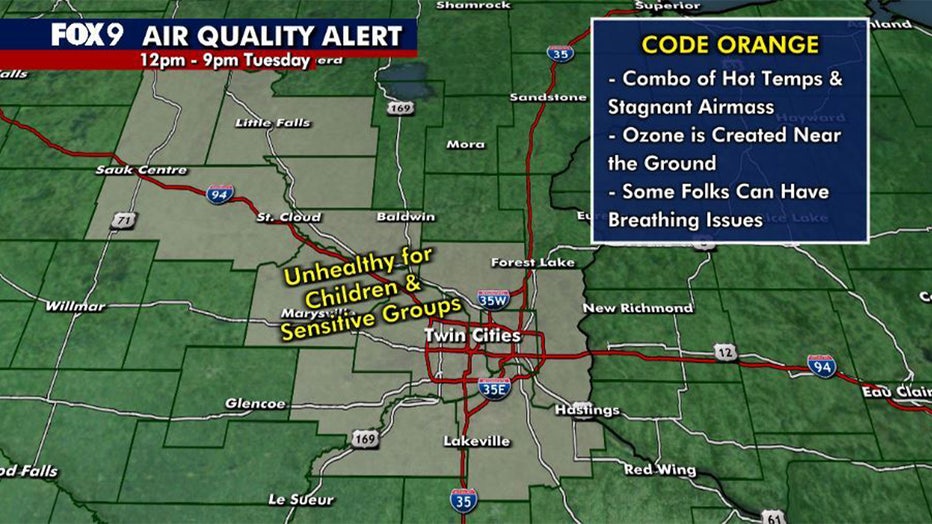
Air Quality Alert in effect from noon to 9 p.m. on Tuesday, June 9. (FOX 9)
Air quality impact:
People with asthma or other breathing conditions are most likely to be affected by unhealthy ozone levels, the MPCA said. Children, teenagers, and people doing extended or heavy physical activity outdoors are also at higher risk.
Unhealthy ozone levels can aggravate lung diseases and cause symptoms including difficulty breathing deeply, shortness of breath, throat soreness, wheezing, coughing, or unusual fatigue. The MPCA recommends using inhalers as directed and contacting a health care provider if symptoms occur.
Precautions and pollution reduction tips
What you can do:
The agency recommends everyone take precautions when the air quality is unhealthy, including taking it easy, limiting or postponing physical activity, and staying away from local pollution sources like busy roads and wood fires when possible.
To help reduce ozone pollution, the MPCA suggests cutting down on car trips, filling up gas tanks at dawn or dusk, using public transportation or carpooling, and postponing use of gasoline-powered lawn equipment. Battery or manual tools are better options on air alert days, and backyard fires should be avoided.
The latest information on air quality conditions can be found on the MPCA website.
The Source: This story uses information from the Minnesota Pollution Control Agency.