

World's first synthetic cell that can grow, divide and replicate created at U of M
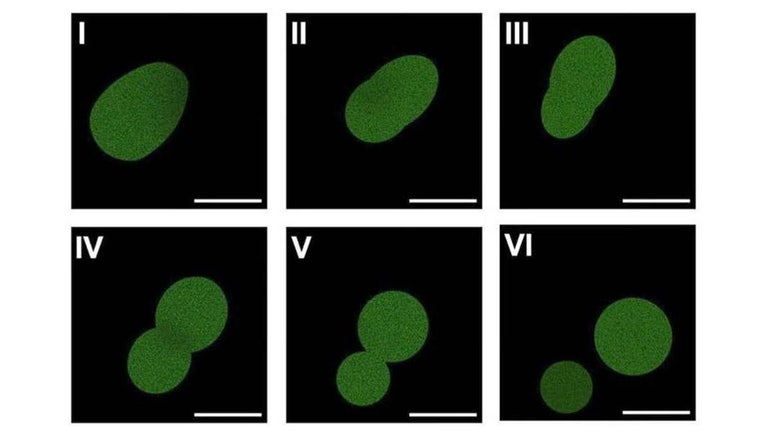
A team of University of Minnesota scientists say they have created the world's first synthetic cell that they believe could revolutionize how scientists create medicines and materials.
MINNEAPOLIS (FOX 9) - A team of scientists at the University of Minnesota has built the world’s first synthetic cell that can grow, divide and replicate, opening the door to new possibilities in medicine and engineering.
U of M scientists build synthetic cell with a full life cycle
What we know:
A press release provided by the U of M says Associate Professors Kate Adamala and Aaron Engelhart led the College of Biological Sciences team that developed SpudCell, which is made entirely from chemical components, but can perform all the basic behaviors of a living cell.
The SpudCell is much smaller than a human cell, with a genome of just 90 kilobase pairs compared to the human genome’s 3 million.
What that means is, instead of dividing like a natural cell, it splits under mechanical stress when proteins gather at the surface.
The cell can also compete and evolve.
The press release details that when researchers introduced a genetic change to increase production of a fusion protein, the cells grew faster and produced more offspring.
After five generations, the faster-growing variant outcompeted the original, especially when nutrients were scarce.
Dig deeper:
The SpudCell project is named as a play on the first space satellite Sputnik, the press release says.
According to university researchers, its creation work could revolutionize how scientists create medicines and materials, since most current methods require altering natural cells or using energy-intensive industrial chemistry.
Further research found that the SpudCell can perform life functions like selection, genome replication, growth, feeding and division, all without the internal scaffolding (cytoskeleton) that natural cells use.
What they're saying:
"We’ve replicated in chemistry what only used to be possible in biology: the complete set of behaviors of a cell. It proves that the most fundamental functions of life, like growth and replication, do not need a mysterious magical spark," Adamala said in the press release. "We are showing it’s possible to engineer the basic functions of the cell."
What's next:
Cells built from scratch could one day create new medicines, materials and chemicals in ways that are more precise and use less energy than current methods.
The university says the next step is to focus on engineering efforts using SpudCell as a shared platform for international collaboration.
The Source: Information provided by the University of Minnesota College of Biological Sciences.