

UN says next five years to smash heat records
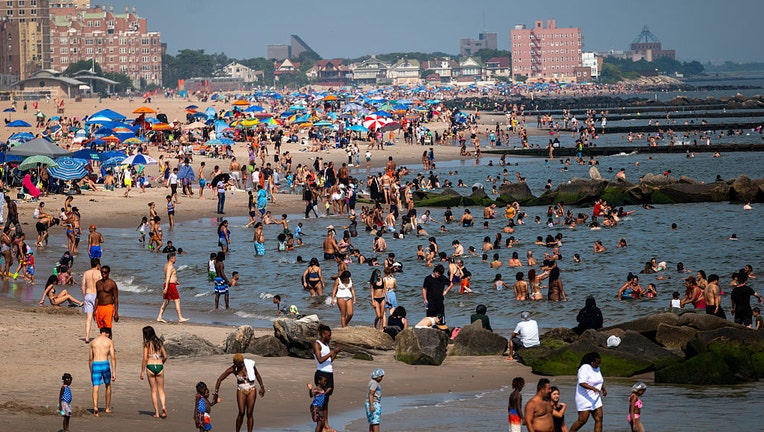
FILE-People try to stay cool at the beach at Coney Island in Brooklyn as the region experiences another heatwave on July 30, 2025 in New York City. (Photo by Spencer Platt/Getty Images)
The United Nations released climate projections showing that in the next five years, the Earth is likely to spike past the international climate threshold and eclipse its hottest year on record.
UN officials also are predicting an overheating Arctic that warms almost 3 degrees between now and 2030 and a dangerous drought with possible wildfires in the Amazon, a critical portion of Earth’s natural defenses to mitigate climate change.
UN heat record prediction
Dig deeper:
According to the Associated Press, the U.N. climate agency and the United Kingdom's Meteorological Office explained that there's a 75% chance that the average global temperature between 2026 and 2030 will be over 1.5 degrees Celsius (2.7 degrees Fahrenheit) higher.
Citing the World Meteorological Organization report, the AP noted that there is a 91% chance that at least one of the next five years will move past the 1.5 degree threshold and an 86% chance that one of those years will smash the record for Earth’s hottest year set in 2024.
RELATED: 2025 was one of the hottest years on record, data finds
The WMO predicts each year between now and 2030 to be between 1.3 degrees Celsius (2.3 degrees Fahrenheit) and 1.9 degrees Celsius (3.4 degrees Fahrenheit).
Moreover, if the next five years were to average over 1.5 degrees Celsius, that means Earth will have warmed a quarter of a degree Celsius (0.45 degrees Fahrenheit) in 10 years, which is faster than the previous rate of warming.
The WMO report also stated that almost all short-term weather forecasts predict a strong El Nino, a natural warming of parts of the central Pacific that may change weather globally and increase temperatures to form soon. The WMO noted that this may extend to 2028.
The Source: Information for this story was provided by The Associated Press, which cites the U.N. climate agency, the United Kingdom's Meteorological Office, and the World Meteorological Organization report. This story was reported from Washington, D.C.