

Northern Lights shine across Minnesota, United States: Photos

Incredible northern lights dazzle across MN, United States
Tuesday's northern lights were among the most intense shows we've seen in decades, with the aurora extending down to central Mexico. FOX 9's Cody Matz explains how this incredible show came to be.
MINNEAPOLIS (FOX 9) - Minnesotans are catching glimpses of the Northern Lights this week, with the National Oceanic and Atmospheric Administration's (NOAA) Space Weather Prediction Center issuing a moderate geomagnetic storm watch for the evening of Nov. 11, a rare G4 (severe) watch for Nov. 12, and a G3 (strong) watch for Nov. 13.
Northern Lights in Minnesota
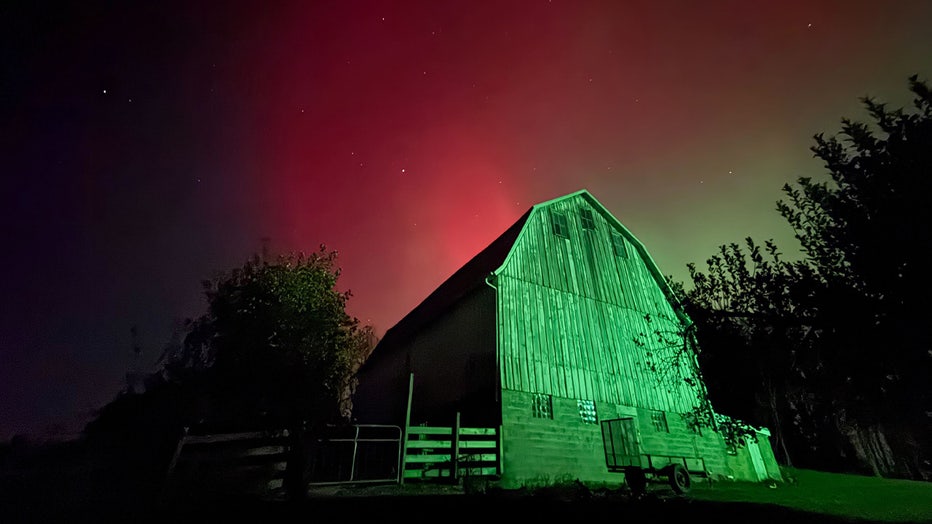
FOX 9 viewer submissions of the Northern Lights seen across Minnesota on Nov. 11, 2025.
What we know:
The sun has recently become very active over the last few days, with at least two solar storms likely on their way toward Earth.
Known scientifically as Coronal Mass Ejections, or CMEs, these solar storms are large bursts of plasma and magnetically charged particles that blast off the sun's corona, or the outer atmosphere. These specifically come from sunspots, or cooler, more unstable sections of the sun that are far more volatile than the rest of the star.
When these spots point toward Earth, they can send an enormous amount of energy in our direction.
When this added energy hits our outer atmosphere, it deflects most of it around the planet and back out into space. This interaction and deflection we see is the Aurora Borealis, or the Northern Lights.
Local perspective:
FOX 9 viewers have submitted photos of Northern Lights seen so far. You can see them in the gallery below:
Tips for seeing the aurora
What's next:
The NOAA recommends the following tips for the best chance to see the Northern Lights.
- It’s generally better to go north.
- To have the best opportunity to see them, get as far away from city lights as possible. You can use this map to find the best spots near you.
- Spring and fall are often the best times to see the aurora, because "the subtleties in the way the solar wind interacts with Earth’s magnetosphere" can create larger geomagnetic storms.