

This is how Americans think the government should respond to natural disasters: Poll

New Mexico father recounts historic flash flood
A father in Ruidoso, New Mexico described the moment the floodwaters overtook an RV park in the small mountain community. At least three people were killed by flash floods, including a four-year-old girl and a seven-year-old boy. Jason Fulcher said his wife was praying together last night, worried about their own children, "because they thought they were going to drown."
As deadly floods swept across Texas over the Fourth of July weekend, claiming more than 100 lives, new polling data reveals how Americans view the relationship between climate change, government responsibility, and weather preparedness.
The Associated Press-NORC Center for Public Affairs Research conducted two national polls earlier this year—before the Texas flooding disaster—that shed light on public opinion surrounding extreme weather. While most U.S. adults agree the federal government should warn the public and help communities recover, there’s less consensus on whether Washington should lead the charge against climate change itself.
The findings suggest Americans trust weather information from government sources but are divided along political lines when it comes to climate policy—something that may influence how leaders respond to future disasters.
Do Americans believe climate change is causing extreme weather?
What we know:
About 2 in 10 Americans say they’ve experienced major flooding in the past five years. Of those, 7 in 10 believe climate change was at least partially responsible.
People in the Northeast and South were more likely to report recent flood impacts.
The data mirrors broader trends: most Americans have faced some form of severe weather, including heat waves, hurricanes, and drought.
What we don't know:
It’s still unclear if the deadly Texas floods will shift public opinion on climate change or disaster preparedness.
The polling was conducted in February and June, before the floods—so updated views may differ as scrutiny grows over emergency response.
The surveys don’t measure how much flooding people experienced, or whether their homes or neighborhoods were damaged.
Where do Americans stand on the government’s role?
The backstory:
Roughly 7 in 10 Americans say the federal government should play a major role in tracking weather events and alerting the public. That includes about 80% of Democrats and around two-thirds of Republicans.
Support is even stronger for post-disaster relief, with 8 in 10 saying the government should help affected communities rebuild.
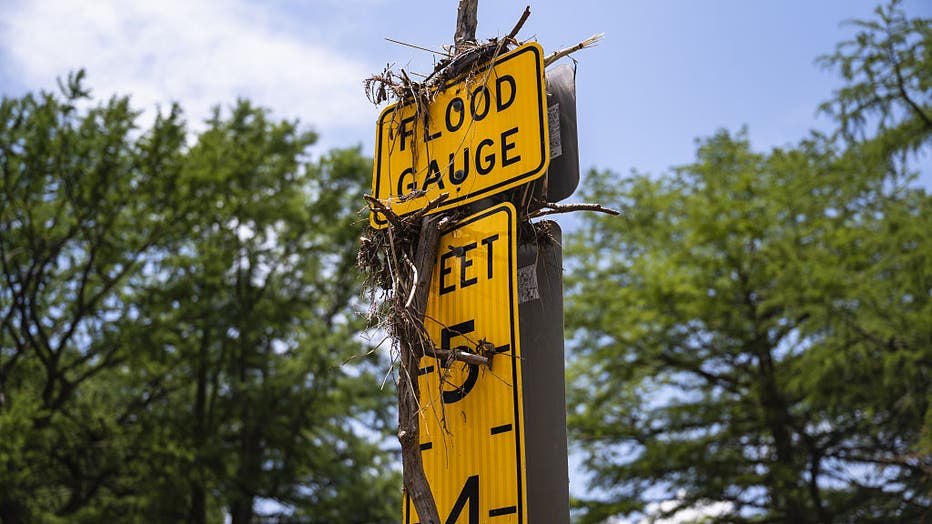
Debris on a flood gauge following the flood in Hunt, Texas, US, on Wednesday, July 9, 2025. (Photographer: Eli Hartman/Bloomberg via Getty Images)
But when it comes to preventing future disasters through climate action, views are more divided.
Only 56% of Americans say the federal government should take a leading role in fighting climate change. The split is sharp:
- 80% of Democrats support a strong federal climate response
- Only about 30% of Republicans feel the same
How much do people trust weather warnings?
What they're saying:
Before the Texas floods, confidence in the National Weather Service and local forecasts was relatively high. In the June poll:
- About 4 in 10 adults said they were "very" or "extremely" confident in their local forecasts
- Another 4 in 10 said they were "somewhat confident"
Trust in the Federal Emergency Management Agency (FEMA) was notably lower:
- Just 2 in 10 were "very" or "extremely" confident in FEMA
- About 4 in 10 were "somewhat" confident
As scrutiny grows over the flood response and alert timing in Texas, those numbers may change—especially if future disasters reveal weaknesses in communication or preparation.
What's next:
With federal and state officials now facing questions about flood alerts and evacuation timing, trust in agencies like the National Weather Service and FEMA may come under pressure.
Future polling will likely measure whether public confidence in weather alerts holds steady—and whether more Americans begin to support stronger climate intervention policies as severe weather events become more frequent and deadly.
The Source: This article is based on public opinion research from The Associated Press-NORC Center for Public Affairs Research. Two nationwide polls were conducted in February and June 2025, before catastrophic floods struck Texas. The data reflects U.S. adults’ attitudes toward recent flooding, the role of climate change, and government responsibility in weather monitoring and emergency response. All statistics and figures were reported by the AP-NORC Center and the Associated Press.