

Alaska's 2026 Senate race: What to know about Mary Peltola vs Dan Sullivan
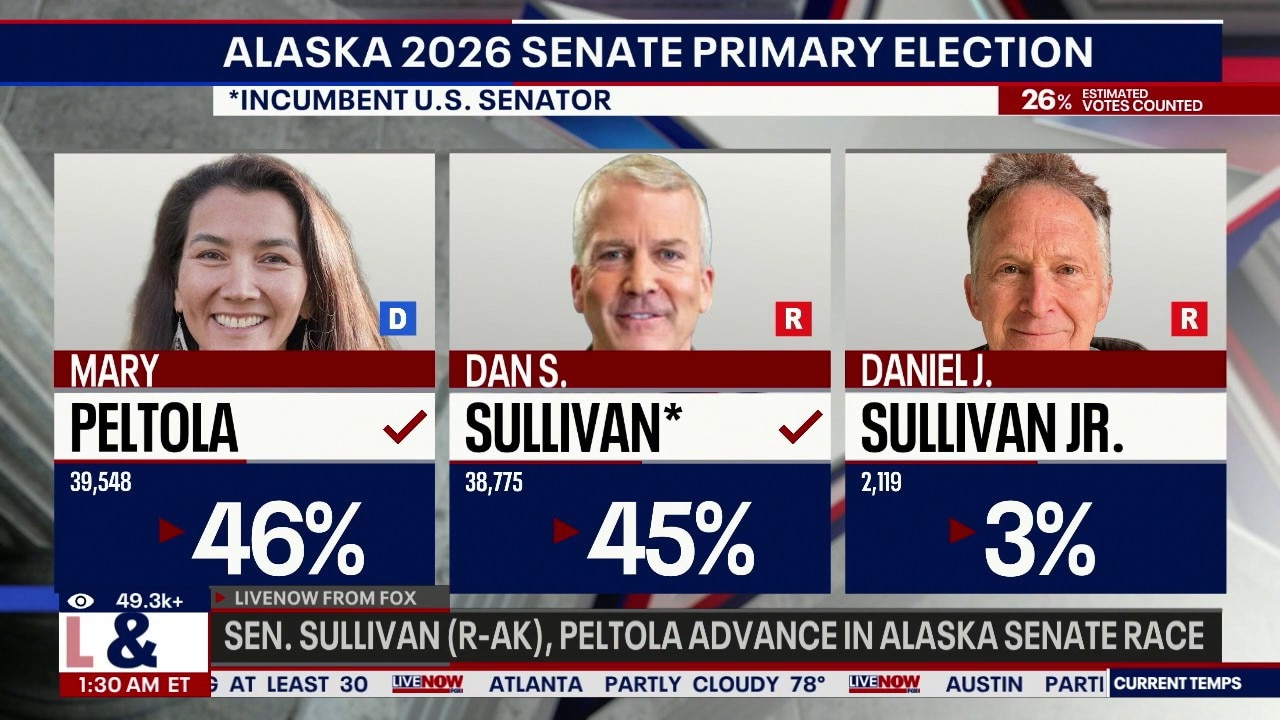
Sullivan, Peltola advance in Alaska primary
We are learning more this Tuesday as four candidates advance out of Alaska’s nonpartisan jungle primary. This includes one race that could decide the balance of power in the U.S. Senate come November. Sen. Dan Sullivan, R-Alaska and former Rep. Mary Peltola, D-Alaska, will advance alongside two other candidates in the state’s four-candidate general election. We are going over the latest results out of Alaska tonight.
Alaska is one of just a handful of states expected to decide which party controls the Senate for President Donald Trump’s final two years in the White House.
Aside from the two Dan Sullivans vying for the last spot (yes, there are literally two candidates named Dan Sullivan in this race), here’s a look at who else is gunning for Alaska’s Senate seat.
Alaska’s Senate race
Dig deeper:
Alaska has been reliably red for many years, but the state has chosen representatives across the political spectrum in the past.
Dan Sullivan (incumbent/Republican) replaced Sen. Mark Beigich (Democrat) and Sen. Lisa Murkowski (Republican) has famously voted against her party’s policies.
This year, there is no clear sign of how the state will vote in its upcoming Senate election.
Most registered voters in Alaska aren’t affiliated with a political party. Both the state House and the state Senate are controlled by bipartisan coalitions.
Who are the candidates?
- Mary Peltola (Democrat)
- Sen. Dan Sullivan (Republican/incumbent)
- Dan J. Sullivan (Republican)
- Gerald Heikes (Republican)
Mary Peltola v Sen. Dan Sullivan

FILE - Side-by-side image of incumbent Republican Sen. Dan Sullivan and Democrat Mary Peltola. (Getty Images)
Democrats have backed former U.S. Rep. Mary Peltola to face incumbent Sen. Dan Sullivan.
Peltola is among a handful of Democrats who have recently won statewide elections in red states, and she vowed to shake up the establishment to make life more affordable for Alaskans.
Peltola, who is Yup’ik, was the first Alaska Native to serve in Congress. She won special and regular elections in 2022 for Alaska’s only House seat, defeating a field that included Republican former Gov. Sarah Palin. In 2024, Peltola lost to Begich.
Sullivan, a former state attorney general and natural resources commissioner, defeated the state’s last Democratic senator in 2014.
Sullivan, a veteran and ally of Trump, campaigned on supporting the military, opening more land for oil and gas extraction, and voting for Trump’s signature tax and spending law.
He is running for a third term.
An AARP poll conducted in September found Sullivan trailing behind Peltola by 5 percentage points.
There’s 2 Dan Sullivans on the ballot
Another interesting aspect of this year’s Senate race in Alaska is that there will be another Dan Sullivan on the ballot.
Dan J. Sullivan was one of four top finishers in Alaska’s August 18 primary election.
Challenger Sullivan is a retired teacher from the island community of Petersburg and actually sued to have a spot on the ballot.
Sullivan is also running as a Republican on the ballot in November.

FILE - Dan Sullivan Jr. candidate submission photo. (Divison of Elections)
What they're saying:
Republicans worry that having two candidates with the same name and party affiliation on the ballot will confuse voters, with some potentially marking the wrong candidate, according to The Washington Post.
Gerald Heikes
Unlike the other candidates, Heikes has no website and did not release an official candidate statement, but he’s on the ballot and running as a Republican.
Of note, he did run for governor in 2018 as a Christian Republican Conservative, as well as in 2014, 2010 and 2006.
He also made a bid for Alaska’s House seat in 2020.
Ranked-choice voting system
Big picture view:
Ranked-choice voting allows voters to rank candidates in order of preference (first choice, second choice, third choice, and so on) rather than selecting just one candidate, according to Alaska’s election information website.
If a candidate receives an absolute majority of first-preference votes, they win outright.
If no candidate achieves a majority, the candidate with the fewest first-choice votes is eliminated. The voters who picked that eliminated candidate as their top choice have their votes redistributed to their next-ranked choice. This instant-runoff process continues in rounds until one candidate secures a majority of the remaining votes.
Alaska voters officially adopted this system in 2020, and it was first implemented in the 2022 election cycle.
Alaska and Maine are the only states to use ranked choice voting for statewide elections, according to the National Conference of State Legislatures website.
Some cities in the U.S. use ranked choice voting for general elections, including St. Paul, Minnesota, Portland, Maine, and several cities in the San Francisco Bay Area.
Other locations use ranked choice voting in primary elections, and this includes New York City. Cambridge, Massachusetts and Minneapolis, Minnesota, use ranked choice voting in multimember districts.
The Source: Information for this article was taken from previous reporting by the Washington Post, The Associated Press, and The Hill. Information from Alaska’s elections website and the National Conference of State Legislature website also contributed. This story was reported from San Jose.