

Minnesota wildfires: Progress continues in containing flames, protecting local properties
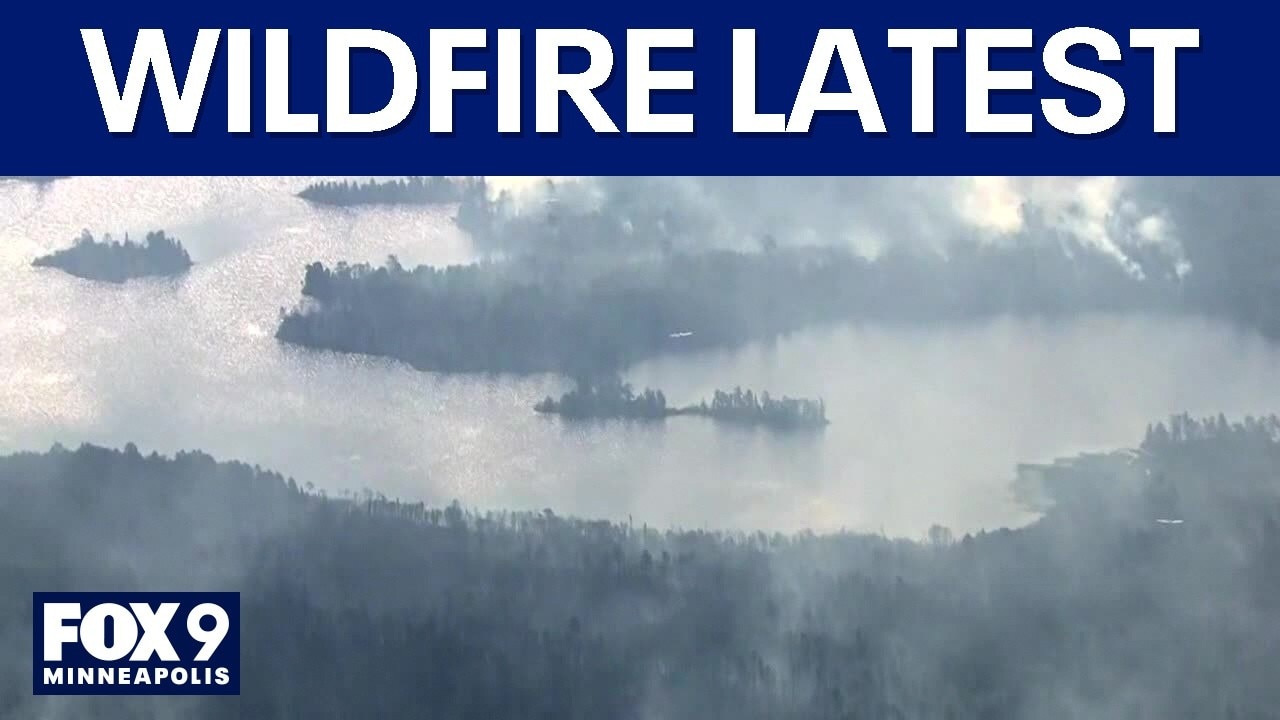
St. Louis County Sheriff gives update on wildfires
St. Louis County Sheriff Gordon Ramsay gave an update on FOX 9's All Day on the northern Minnesota wildfires.
(FOX 9) - Firefighting crews report continued progress in the fight against Minnesota wildfires as they mop up hot spots and strengthen containment lines to protect infrastructure in the area.
Northern Minnesota wildfires update
Big picture view:
Authorities have slowed the spread of multiple wildfires, known collectively as the July Lightning Incident, as they work to set up and strengthen containment lines.
Crews say they are working to keep the fires north of Echo Road.
The St. Louis County Sheriff said late on Saturday that "Fire activity has settled down compared to what we were seeing a few days ago."
By the numbers:
Combined burned acreage from the July Lightning Incident, as of July 26, 2026, is at 64,156 acres in the United States and 8,443 acres in Canada.
Officials say there is a total of 1,274 personnel responding to the July Lightning Incident and 87 personnel on the Little Knife Fire, which started in Ontaio, Canada and spread into the United States.
There are also six Complex Incident Management Teams (CIMTs) and one National Incident Management Organization (NIMO) team responding to the fires.
Local perspective:
The Incident Management Situation Report for July 26, 2206, shows five new fires, and six large uncontained fires.
The large fires that crews are actively fighting include the following:
- The Camp Fire: Located five miles north of Winton, is threatening communication infrastructure and has prompted evacuations, as well as area, road and trail closures. Crews are focusing their efforts along the croquet line, and recent rainfall has provided some relief. The fire has burned about 4,407 acres and the fire is about 39% contained.
- The Sioux Fire: Located about 20 miles northwest of Ely, is also threatening homes and communication infrastructure. More crews have been deployed to the southern part of the fire to create an "anchor point" for future operations. About 12,668 acres have burned and the fire is about 27% contained.
- The Bear Trap Fire: Located 20 miles north of Ely, continues to threaten numerous structures. Like the Camp Fire, it received precipitation yesterday, but moderate fire behavior with backing, flanking and isolated torching persists. Combined with the Dark Fires, about 37,837 acres (29,767 acres in the United States) have burned, and the fire is about 38% contained.
- The Chub Fire: Located 14 miles north of Orr, is showing minimal fire activity, but still threatens structures and communication infrastructure. Crews are responding to hot spots, with improvements expected in the coming days. The fire burned 344 acres and is 95% contained.
- The Thumb Fire: Located five miles south of Lac la Croix, saw firefighters complete their mission, and they are now returning from the area. A total of 17,236 acres have burned (16,890 acres in the United States) and the fire is considered 56% contained.
- The Little Knife Fire: Located 45 miles northeast of Grand Marais, is transitioning command from one national incident management team to another and is currently showing minimal fire behavior. Officals say a smokejumper module will be inserted by canoe and will join a hotspot crew to focus on securing the eastern perimeter of the fire. About 4,958 acres have burned, and the fire is considered 38% contained.
What's next:
Crews are hoping that rain, forecasted to fall in the region on Sunday night, will assist in the fight against the wildfires.
Evacuation zones being lifted
Local perspective:
Evacuation orders are being lifted in St. Louis, Lake, and Cook counties as fire crews make progress on the fires.
Most zones in St. Louis and Lake counties will be lifted with a few exceptions. In Cook County, zones in the BWCA will be opened up.
You can click here for more information.
Why do fires start underground?
Dig deeper:
The U.S. National Forest Service-Superior National Forest explained the challenges in managing wildfires when many of them start underground.
Glaciers once scraped Minnesota down to bedrock, and over time, layers of organic material called "duff" formed above the mineral soil. This duff is full of nutrients and air pockets, making it a perfect place for plants—and, unfortunately, for fire to travel.
A lightning strike can ignite a tree, and the fire may follow the trunk down into the roots. Because there’s enough oxygen in the duff, the fire can smolder underground, sometimes traveling from root to root or finding an exposed patch of duff where it flares up at the surface.
During years with normal rainfall, the duff stays too damp to burn. But this year, with only one quarter to one half of the usual rainfall, the duff is dry enough for fires to smolder deep underground and reach the roots of large trees.
When the roots burn away, they leave behind hollow spaces called ash pits. These pits can be hot enough to cause serious burns if someone falls in.
Firefighters are trained to look for signs of ground fire, but it’s challenging to find hot spots burning one to two feet below the surface. When they do find them, they dig through the duff to the mineral dirt and douse the area with lots of water to fully put out the fire.
Firefighters say that a lightning strike can start an underground fire that smolders for days, weeks or even months before it’s discovered and extinguished.
The Source: This story uses information from U.S. Superior National Forest and previous FOX 9 reporting.