

Minnesota icon or complicated character? Bemidji's Paul Bunyan statue nears 90th birthday
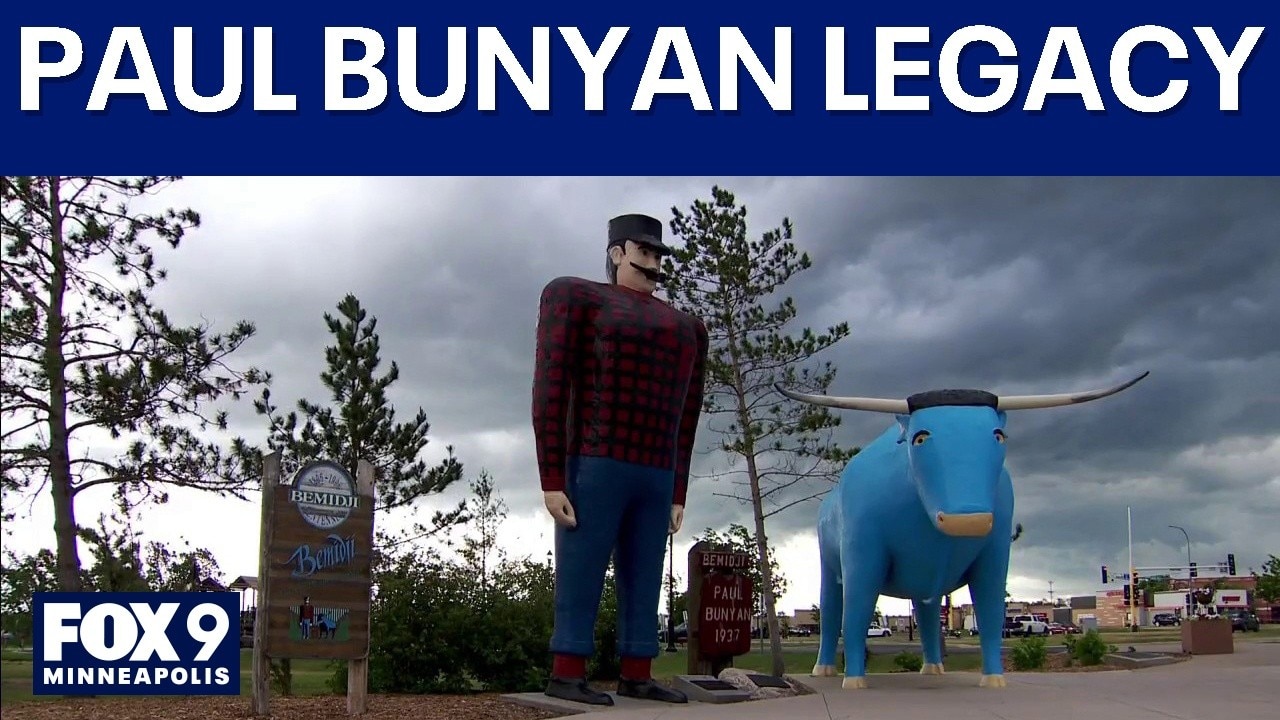
Bemidji's Paul Bunyan statue turns 90, legacy examined
The legend of Paul Bunyan is ingrained in Minnesota history, and his statue is a symbol of local pride to Bemidji residents. FOX 9's Maury Glover takes a closer look at the legacy the statue represents as it nears its 90th birthday.
BEMIDJI, Minn. (FOX 9) - The iconic Paul Bunyan statue on the shores of Lake Bemidji is about to mark a major milestone, and the story behind this larger-than-life figure is as colorful as the statue itself.
Paul Bunyan statue’s legacy in Bemidji
What we know:
The Paul Bunyan statue stands 18 feet tall, weighs two and a half tons and has been a symbol of Bemidji for nearly 90 years.
Visitors say it’s more colorful and impressive than other Paul Bunyan statues, with Patty Multon saying, "I've seen other tall, bigger Paul Bunyans but I've never seen one so colorful." Lisa Dawson added, "He's great. Bigger than I thought."
The statue, along with Babe the Blue Ox, draws about a quarter of a million people every year, according to Visit Bemidji.
"Paul Bunyan is a very big deal here in Bemidji and it's, you know, we've embraced it. It's in the fabric of our culture here in Bemidji and it has really become really a major part of Bemidji's identity over the years," said Josh Peterson, Visit Bemidji's executive director.
The statues were built by civic leaders in 1937 as part of a winter carnival to attract tourists. Babe was even mounted on a truck and paraded around town and later in St. Paul, with pipes making it look like he was exhaling cold air.
The statue’s popularity has inspired other communities to build their own giant statues, and Paul and Babe were featured in Life Magazine twice as the second most photographed sculptures in the country, after Mount Rushmore.
The statues were placed on the National Register of Historic Places in the late 1980s.
"There's other Paul Bunyan statues around the United States, but Bemidji gets to claim the first statue in the United State to recognize Paul," said Peterson.
Locals say the statues are a symbol of the community’s strength and identity.
"I think it's just a symbol of Bemidji's strength as a community," said Peterson.
The history and myth of Paul Bunyan
The backstory:
The legend of Paul Bunyan started in North American logging camps in the mid-1800s. While many now associate Bunyan with Minnesota, the first records of stories about him came from Tomahawk, Wisconsin.
"Many of the stories revolved around his prowess as a logger, his great ability, his strength," said Kasey Keeler, director of American Indian and Indigenous Studies at the University of Wisconsin.
In the 1920s, the Red River Lumber Company published a pamphlet about Bunyan’s exploits to publicize its move from Minnesota to California. Newspapers picked up the stories, and Bunyan’s legend—and size—grew.
"He began as, you know, a larger man, you know, six feet, six-feet-four, whatever, you know, staturally he was tall and big, but not the 18-foot-tall giant we see at Lake Bemidji today, right?" said Keeler.
By the 1950s, Bunyan was credited in stories with clearing the way for settlement across the country. But some experts say these tales leave out the real impact of logging, including deforestation and the displacement of Indigenous people.
"So again, Paul Bunyan then becomes this really romanticized image of the white male labor that built the country. But it's just that, it's a myth, it's a story, right? That ignores the brutal reality, the violent history of settler colonialism on our continent," said Keeler.
Native American perspectives include stories of Bunyan battling an Ojibwe trickster, who defeats him and sends him out west, preserving some of Minnesota’s trees.
"It's fun to talk about Paul Bunyan because in many ways he unites all of us. I would say it's something we can be proud of, but to also do the deeper digging. Finding that balance, what do these stories represent and what is the history that's being overlooked by telling only one celebratory story of the golden days of logging," said Keeler.
Paul Bunyan’s continued impact
Why you should care:
As Paul Bunyan approaches his 90th birthday in January, the statue remains a major roadside attraction and a point of pride for Bemidji.
"Whether you love him or hate him, you can't deny the impact that it's had on the economy and the identity and what it's built for this community over almost 90 years," said Peterson.
The statue not only brings in visitors but also sparks conversations about the state’s history, identity and the stories communities choose to celebrate.
The Paul Bunyan statue and its story continue to stand tall—both physically and culturally—in Minnesota’s northwoods.
The Source: This story uses information gathered by FOX 9 reporter Maury Glover.