

The hype on FIFA's new hydration break mandate
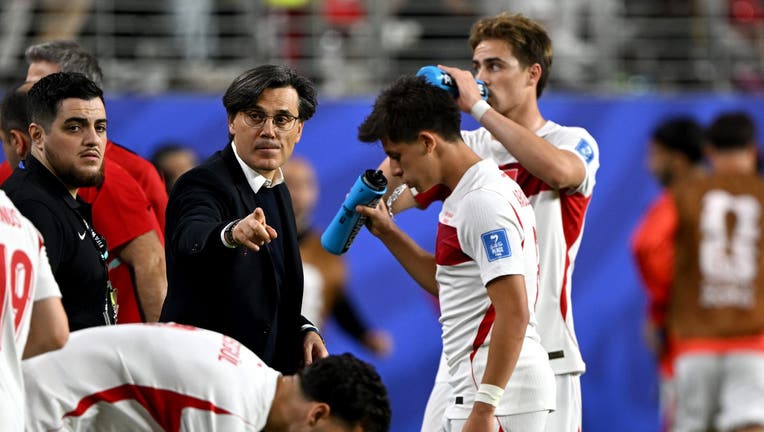
Head coach Vincenzo Montella (C) talks player Arda Guler (front) and Kenan Yildiz (rear) during a hydration break at the 2026 FIFA World Cup First Stage Group D match between Turkiye and Paraguay at the San Francisco Bay Area Stadium (Leviâs Stadium)
The 2026 FIFA World Cup is seeing a slight change from what many would normally expect to see in World Cup play, or any other soccer match.
If you have watched a game at some point over the past couple of weeks, you’ve certainly seen it. About halfway through each half of 90 minute play, the game is paused for hydration breaks, where all players break to rehydrate before continuing again.
For the first time in its 96-year history, FIFA is mandating all players to take hydration breaks. And while some have criticized the new rule for interrupting the game’s flow, giving a chance for a game’s momentum to shift, some experts say it’s absolutely necessary due to concerns about the extreme heat.
Mandatory hydration break
The new approach calls for a three-minute hydration break, 22 minutes through each half. Additionally, breaks are to be imposed in all matches, regardless of weather conditions, to ensure equal conditions for all times.
What they're saying:
The measure was announced by Manolo Zubiria, Chief Tournament Officer, USA, at last year’s World Broadcaster Meeting. "For every game, no matter where the games are played, no matter if there’s a roof, (or) temperature-wise, there will be a three-minute hydration break. It will be three minutes from whistle to whistle in both halves."
Coaches as well as fans are speaking out about it, specifically about the event being marred by fans on site and those at home when the game takes that opportunity to cut to a commercial.
Mexico coach Javier Aguirre still uses it to his advantage as much as possible. "You can’t get on the field but the players can come near you while drinking water and we can give them instructions," he said. "We take advantage to try to correct something during the game, it’s something good for the coaches."
America’s extreme heat
Many of us do not need the reminder that walking outside can sizzle as much as your favorite curry dish. Some weather experts have added that the summer heat for this World Cup in the U.S., Mexico and Canada could be the hottest in the tournament’s history.
Athletes are among the highest risk of exertional heat illness by pushing themselves physically in hot and humid conditions.
Yuri Hosokawa with the Faculty of Sport Sciences in Japan’s Waseda University says that when an athlete's body temperature exceeds 105 F (40.5 C), they may start to feel confused, aggressive or even lose consciousness. It could also lead to fatigue, headaches, irritability, nausea, dizziness and other signs of heat-related illness. Dehydration increases that risk, making exertional heat stroke one of the leading causes of death in athletes.
The other side:
Combating those heat illness concerns is a chief reason why some experts say the hydration breaks should be even longer. A 2024 study found that a three-minute hydration break lowered athletes’ core temps by 0.72 F during simulated soccer running in a heat chamber.
Julien Périard, Director of the University of Canberra Research Institute for Sport and Exercise, said the break should be well planned and used properly. "Even in ideal settings, the breaks can slightly help but will not eliminate the risk of heat illness in response to a rise in core temperature."
The Source: This story was written with information provided by The Associated Press and FIFA. This story was reported from Orlando.