

Wakesurfing critics pushing for local bans, limits on Minnesota lakes

Wakesurfing critics pushing for local bans, limits on Minnesota lakes
Wakesurfing has gained a lot of popularity in recent years, and it's fueling a big debate over how we share our lakes here in Minnesota. FOX 9 Investigator Nathan O'Neal digs into the issue that's pitting neighbor against neighbor.
MINNEAPOLIS (FOX 9) - Wakesurfing critics have launched a campaign to help craft local bans or regulations across Minnesota, citing concerns over the sport’s impact on lake environments.
Critics say thousands of Minnesota lakes unfit for wakesurfing
The backstory:
Wake boats are specially designed to sit deeper in the lake to displace more water and create a bigger, more surfable wave.
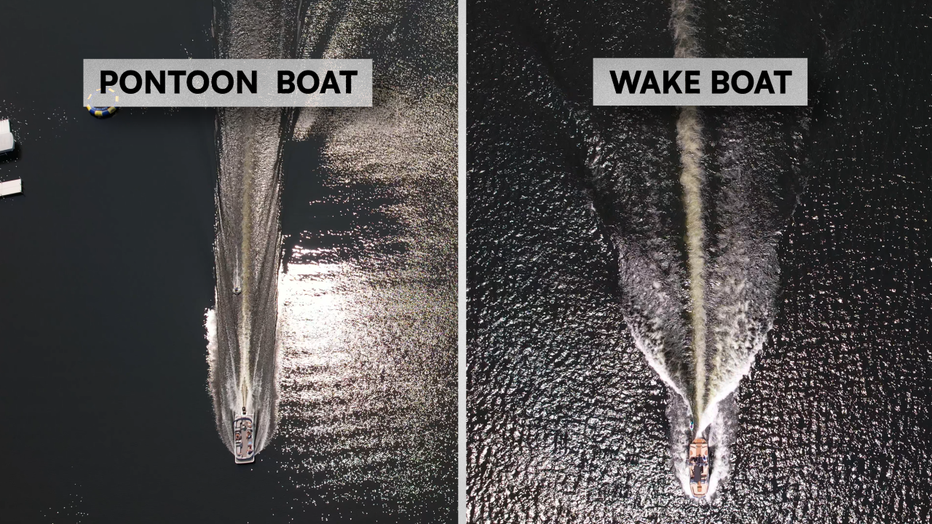
Drone images captured by FOX 9 show the differences in wakes left by a pontoon and a wakesurfing boat.
While many of Minnesota’s lakes have rules that regulate wakes, there is no state law that restricts wakesurfing. Efforts to restrict wakesurfing, including distance required from the shoreline, previously failed at the Minnesota Legislature.
What they're saying:
"To me, it’s not okay to do environmental damage or to risk other people’s safety for your fun," said Chuck Becker, of the organization Safe Wakes for Minnesota Lakes.
Safe Wakes is helping guide local communities across the state craft local ordinances to either restrict or ban wakesurfing on Minnesota’s lakes.
"For the smaller lakes, the more shallow lakes, I would suggest they’re just not appropriate for enhanced wake sports," Becker said.
Steve Frawley, who is also a member of Safe Wakes, has serious concerns over the impact wake boats have on shorelines and on lake beds.
"I’ll see all kinds of vegetation that was torn up from the lake bottoms," Frawley said, who has a home on the Gull Chain of Lakes. "There’s a huge impact on shore lines."
Wakesurfing business owner Adam Moore is opposed to local efforts to further restrict the sport.
"It’s a little frustrating because they constantly bring up things like we’re ruining the lake shore, the shoreline, we’re wrecking the bottom of the lake," Moore said. "If you go out on any decent-sized lake on a windy day, those waves that are coming into shore on a windy day are way more aggressive than any wakesurf boat."
Caribou Lake wakesurfing ban
By the numbers:
Safe Wakes estimates out of more than 11,842 lakes in Minnesota, only about 500 of them are big enough and deep enough to accommodate wakesurfing.
Becker said the group is currently working with seven lake communities to explore implementing an ordinance, calling it "the best option" in the absence of a state law to regulate wakesurfing.
Last year, Cook County leaders in northern Minnesota unanimously approved an ordinance to effectively ban wakesurfing on Caribou Lake.
"We're hoping that other lakes do pursue this, just like Caribou [Lake] did, and that the dominoes will start to fall," Becker said.
Neighboring Wisconsin restricts wakesurfing on hundreds of lakes
In recent years, communities across Wisconsin have leveraged local ordinances to enact more restrictions and bans on wakesurfing.
There are now at least 400 lakes in Wisconsin under a wakesurfing ban or restriction.
"We’d like to see the same thing happen within the State of Minnesota," Frawley said.
Limited restrictions on speed and distance to the shoreline previously led to fierce debate on Lake Minnetonka.
Efforts to outright ban the sport in some communities are alarming business owners.
"What are we going to limit next?" Moore said.
The other side:
Dan Van Ampting considers wakesurfing a family affair.
"Our daughter did her first competition at age five and our youngest is getting ready to do her first one here soon," Van Ampting saaid
He worries about over-restricting lakes and believes more focus should be on educating people on "how to use the lakes respectfully."
"There’s certain things you can do–the way you drive and the way that you spend a day wakesurfing – that can minimize the impact on the lake," Van Ampting said.
Conflicting studies over wakesurfing impacts
Dig deeper:
In the case of Caribou Lake, petitioners cited a study by the University of Minnesota, which found wake boats need a distance of more than 500 feet to decrease waves similar to that of a standard recreational boat operating at 200 feet.
The study did not specifically evaluate the effects on the shoreline.
A separate study commissioned by boating enthusiasts and published in the Journal of Water Resource and Protection found that when operating a wake boat 200 feet from shore and in just 10 feet of water, the "environmental impact is minimal."
However, critics urge caution over industry-sponsored studies since two of the authors listed on the study are employees of Mercury Marine, which manufactures boat engines.
What's next:
Local ordinances to restrict or ban wakesurfing on Minnesota lakes require a petition process and approvals by local governments and the state. Any ongoing efforts would likely take months before any action is taken.