

Minnesota Secretary of State candidate and incumbent Steve Simon on voter rights and accessibility
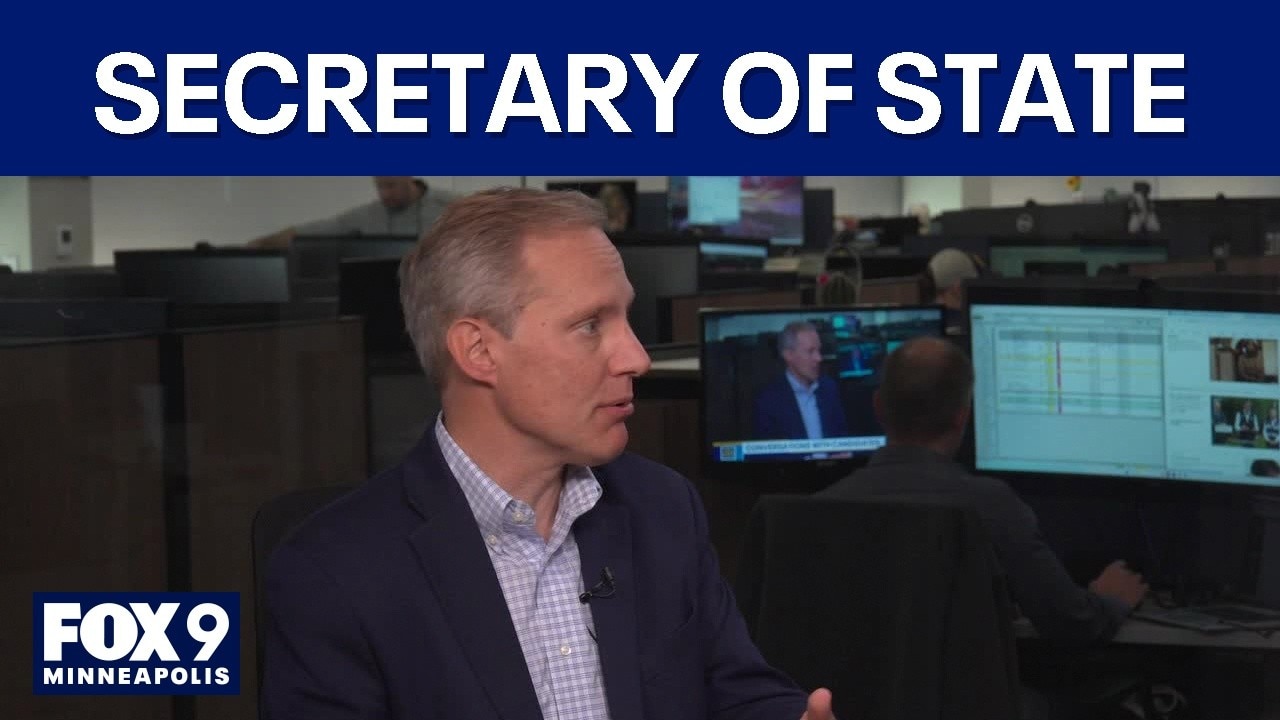
Secretary of State election: Steve Simon
FOX 9's Rob Olson sat down with Minnesota Secretary of State Steve Simon ahead of the 2026 election as part of All Day's "Conversation with Candidates."
(FOX 9) - Minnesota Secretary of State Steve Simon, a Democrat seeking another term in office, joined FOX 9's Rob Olson for the All Day "Conversation with Candidates" series.
His Republican challenger, Tad Jude, previously appeared on FOX 9 to discuss his own campaign.
QUICK LINKS: Minnesota voter guide | How to vote early in Minnesota | Get the latest politics & election news
Simon discusses his background and interest in elections
"To me, I was always into these democracy issues, because to my way of thinking, they're tied to every other issue. Because whatever you care about the most, whether that's jobs or the environment or schools or healthcare or whatever, all roads sort of lead to the ballot box, because you're not going to get very far unless you get people who support your views and values into office. And you're going to not get that unless you have an election system that works for everybody. And so that was kind of the thing for me."
Simon explains his views on voting accessibility
"Yeah, so my mother was an immigrant, and I know how it is for immigrants. I grew up in a bilingual household. She was from Austria, and to me, I saw that through her eyes, what that was like. And so that's led to things like, look, we should be providing voting or elections-related things in other languages, right? Because I know that my mom was wired to understand technical information. I don't care whether it's a refrigerator manual or a government document. If it was in her own language. So that's just one bit that really made an impression on me because I saw how she navigated all that."
Simon discusses his family's history and the importance of voting rights
"Yes, well, on the other side of my family, you know, my family, I like to say, didn't just immigrate but fled from Eastern Europe once upon a time over a century ago, and they didn't have a lot of rights where they came from. One of the rights they did not have been the freedom to vote, and they came here to northern Minnesota at first in the Iron Range and found a better life and found that they finally had a say in who governed them and how and that's something that's never lost on me."
Simon on voter ID requirements
"Well, first of all, Minnesota voters a few years ago had something to say about that. Right, right, and it went down. But regardless of all of that, here's what I say. In Minnesota, remember, to even get into the system, to even register to vote, you have to show with documents that you are who you say you are and you live where you say you live. The difference, to my mind, is we have a common sense, flexible list of things you can use. Not only, not just, a government-issued photo ID. You can use a utility statement to show part of those things. You can have a neighbor vouch for your residence. You can do all those things, so I think in any election system, ours or any other one, you're always looking for a balance between access and security. You need both. You need a blend of both. And this is one of those issues that sometimes you just got to be careful. The more you look, sometimes the less you like. I'll give you an example. I do, I travel to all 87 counties in Minnesota regularly, and on occasion, I'm at a senior or assisted living facility, and I always do a quick sort of flash poll. I say, raise your hand if you have a government-issued photo ID that shows this address. Not where you came from, not the apartment or home you lived in last year, but now that you're here at this facility. Your current address. I've never gotten to 50%. So, it's just something we've got to go slow on. I'm not saying there isn't any combination of things we could have. I'm not saying that. But we really got to be careful because we don't want to shut out eligible voters."
Simon says providing free voter ID cards would be a step in the right direction
"I think that's a step in the right direction, absolutely. I think you'd have to do that. I mean, one of the things I think most people agree with is if you had that system, you'd have to provide a free ID, including IDs for people who maybe no longer drive, right? They don't have a driver's license, so they'd need something, whether it's what I was doing or someone else, that would be the way to go.
Simon addresses concerns about voter impersonation at polling places
"Well, you used the exact right phrase, which few people do, which is voter impersonation is the one and only species of voter fraud that that would get at. It wouldn't get at the other stuff, just that. And that is exceedingly, exceedingly rare. It's really microscopic. So are those things possible? Yeah, they're possible, but you're gonna get nailed, you're going to get caught."
Simon explains why he believes voter impersonation is rare
"Yeah, I mean you look back since I think the figures that I saw were since I think the 2014 or 2015 election year and you look at the statistics and it really really is tiny because you're gonna get caught the few times when people do try something like that you're going to get caught."
Simon explains how Minnesota identifies potential voter fraud
"Because we exchange all sorts of data up, down, and sideways. We screen every single, not only vote cast or voter who casts a ballot, but even voter registration through multiple databases. And this is where we get to things like non-citizens or people who attempt to double vote, either within Minnesota or outside the borders of Minnesota. Dead people, for example, we run all that stuff, all of the millions of voter registrations through two death databases. So, you know, when it comes to the data. Nothing is perfect, no data set is perfect but we, I think in Minnesota, historically have done a really good job of creating a very secure system."
Simon responds to felony charges against James O'Keefe and Cam Higby over alleged voter impersonation
"Well, let me take the second part first. I leave to the prosecutors all the facts and who did what and whatever. That's fine. My view on all that is this. Everyone has a First Amendment right to make their political statement, to dress up in outfits or costumes, to yell into a bullhorn, to do anything they want. But we do have to draw the line at breaking certain laws in our actual polling places. Do what you want. The First Amendment's meant to protect unpopular speech, not popular speech. So go for it. You have every right. But surely we have to draw a line. And at least the charge is that they were impersonating voters. Now, who knows what a judge or jury will say? That's not for me to say. But I do think we've got to be cautious about that. We've got to have our polling places be islands of calm. In terms of their particular video, I agree with what's embedded in the question from the caller here or from the viewer, which is that, if anything, this demonstrated the security of the system. It was a mischaracterization of vouching. Vouching in Minnesota pertains only to residence. So my dad used it once upon a time when my parents moved from the house I grew up in to another city just a few weeks before the election. So a voucher is only vouching for someone's residence. They're not vouching that they're a citizen or that they are even eligible to vote at all. Just, hey, that guy really lives at that place. And then what the videos don't show you and why this vindicates the system is what happens then? Is the person like my dad just waved in, no questions asked? No, all the questions are asked. So my dad then, and every Minnesotan who uses it now, has to provide a driver's license number. The vouchee, let's say, has to provide a driver's license number or a partial Social Security number or a state ID number. So this narrative out there that they were trying to stoke of, oh my god, these random people are just waved in with no questions asked. You never got there."
Simon explains why Minnesota refused to provide certain voter information to the federal government
"Right, right. And that's our office, not the Walz administration. Well, look, the federal government demanded that every state turn over every speck of information they had on every one of our millions of voters. We looked at the law, and the law to us was clear, they don't get that information. So we said no. They sued us and 34 other states. And so far, the Justice Department is 0 and 27 in those lawsuits, including in Minnesota. So all the courts, unanimously so far in the country, have agreed with us. That under the law they don't get that. It's not about hiding things, it's about they can have everything. They can have name and address and voting history and birth year. They could have all of that. But they can't have this stuff, like our Social Security numbers, our driver's license numbers, etc. And the courts have universally, 27 times, including Minnesota, agreed with that."
Simon explains his concerns about sharing sensitive voter information with the federal government
"Because they're not entitled to that data and they don't need it as they have somewhat admitted for the work that they say they want to do. They don't need the Social Security information, they don't need the driver's license information to do what they say that they want to do with it."
Simon outlines his priorities for another term as Secretary of State
"I think elections are about the future. So in the future, I think this office is about offense and defense, defense, making sure that no one interferes with our freedom to vote from Washington or any place else. Offense, we could do even better when it comes to access. I don't mean voter access, I mean public access to the inner workings of elections. And we can open up a lot more of the processes. We do a lot now, but even more so that people can just watch, look at what's under the hood, satisfy themselves that things are secure."
The Source: This story is based on and interview transcript.