

House report blames Walz, Ellison for ignoring fraud warnings signs
New fraud report blames Minnesota leaders
A new federal report alleges Minnesota’s top officials failed to stop fraud even after concerns were flagged, as Governor Tim Walz and Attorney General Keith Ellison have both defended their efforts to combat fraud over the years.
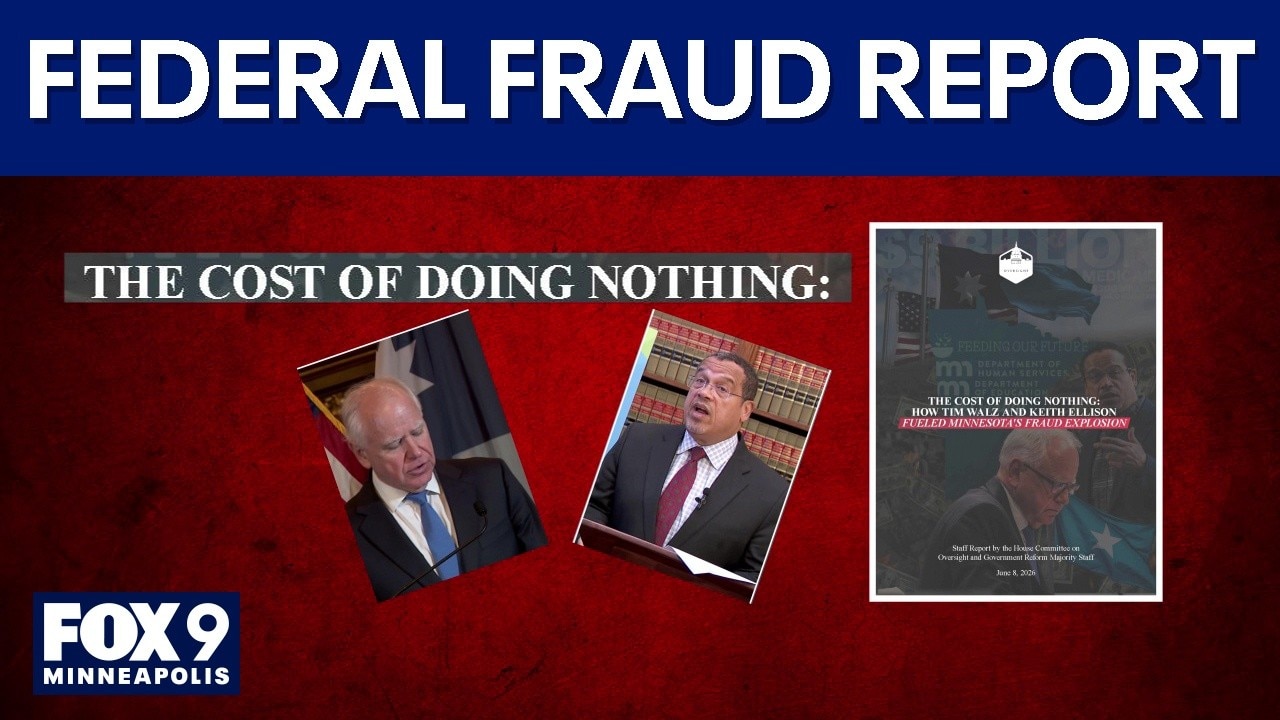
ST. PAUL, Minn. (FOX 9) - A report issued by a GOP-led Oversight Committee in the U.S. House is accusing Gov. Walz and Attorney General Keith Ellison of failing to take action against fraud for years.
Minnesota fraud report
What we know:
The report issued by the committee led by Rep. James Comer (R-Kentucky) blames Walz for not acting sooner to combat the fraud. The report follows months of hearings and investigation by the committee into Minnesota, including a March hearing when Gov. Walz and Ellison testified.
The report builds off an interim report issued in early March on the same day Walz and Ellison testified.
Dig deeper:
The report accuses Gov. Walz and Attorney General Ellison of being aware of widespread fraud in state Medicaid programs dating back to 2019 but failing to act to stop the fraud.
The report cites testimony from former Department of Human Services Commissioner Jodi Harpstead, who states she would regularly brief Gov. Walz's chief of staff on concerns of fraud starting at the beginning of her tenure in 2019. However, it's not clear if those reports ever made it directly to the governor.
Former DHS Commissioner Tony Lourey also testified he briefed the governor's chief of staff about fraud in a child care program in 2019. However, during testimony in March, Gov. Walz said he couldn't recall details about that briefing.
Walz and Ellison respond
The other side:
In a statement to FOX 9, Gov. Walz spokesperson Teddy Tschann writes: "This committee has proven time and time again to be nothing more than a joke. They continue to rehash COVID-era fraud to distract from endless wars, gas prices, ICE, and the President’s insider trading. Governor Walz is glad to see fraudsters are going to prison. If the committee is concerned about corruption, they should investigate why President Trump continues to let fraudsters out of prison."
Dig deeper:
Harpstead also said she would regularly submit reports about fraud to the Attorney General's office. However, the Harpstead transcript seems to indicate these were fairly standard fraud reports – not anything that would necessarily indicate widespread or major fraud cases. Harpstead also testified that she felt Ellison was taking fraud cases seriously and wasn't ignoring the fraud.
In a statement to FOX 9, a spokesperson for Ellison points out that the report criticizes the attorney general for not acting on Child Care Assistance Program fraud. However, the spokesperson points out the AG doesn't have the authority to prosecute CCAP cases. However, the report does point out the AG could bring civil cases.
"A statement from the AG's office reads in part: "Republicans in Congress issued a report riddled with inaccuracies and misrepresentations in an effort to politicize the issue of fraud, instead of actually helping Minnesota protect tax dollars and go after fraudsters.
"The record is clear that Attorney General Ellison fought fraud wherever possible and as soon as he was able to. In areas where Attorney General Ellison has the authority to file criminal charges, he has charged and convicted over 340 Medicaid fraudsters. In fact, Attorney General Ellison's Medicaid Fraud Control Unit regularly ranks as one of the most effective Medicaid fraud-fighting units in the nation.
"In areas where Attorney General Ellison does not have criminal jurisdiction, he has defended the state from frivolous litigation filed by fraudsters to hide their schemes, assisted federal authorities in their investigations, and used his authority to regulate charities to investigate and shut down charities used to perpetrate fraud.
"Attorney General Ellison has taken the issue of fraud seriously and worked to combat it since he was first elected and will continue fighting fraud and protecting Minnesotans' tax dollars. Just recently, Attorney General Ellison’s legislation to increase the size of his Medicaid Fraud Control Unit, give the unit greater investigative authority, and strengthen state Medicaid fraud laws passed the legislature with overwhelming, bipartisan support."
Report accuses state of retaliating against state employees that raised concerns
Big picture view:
The report also accuses the state of retaliating against the state employees that tried to blow the whistle on fraud.
The report includes a bizarre email from a DHS manager that threatened to use "military intelligence" to track a whistleblower that sent an email raising concerns about fraud in state programs.
The state did try to shut down Feeding our Future in 2020
The other side:
It's worth noting the state did try to shut down the Feeding our Future fraud scheme in 2020. In November 2020, the Minnesota Department of Education stopped approving new sites for Feeding our Future due to fraud concerns. Ultimately, Feeding our Future sued, and eventually the state pulled Feeding our Future's funding.
What happened next is the subject of some debate, but ultimately, the state voluntarily resumed funding to Feeding our Future. The Feeding our Future case ultimately cost taxpayers $300 million.
State officials say the USDA failed Minnesota
Local perspective:
Comer also released full transcripts of interviews the committee conducted with Minnesota state officials.
An interview with Assistant Minnesota Department of Education Commissioner Daron Korte shows that the state wanted to act against Feeding our Future in early 2020 but felt they lacked support from the USDA to take against the fraud scheme.
Korte says they kept reaching out to the USDA to move forward with terminating Feeding our Future's funding but couldn't get a response back. Korte's admits the state could have shut Feeding our Future down themselves, but officials knew it would have gone to the courts and without the USDA, the decision would have been overturned.
During his testimony in March, Gov. Walz made similar statements regarding the USDA.
"The characterization that nothing happened until the Trump administration came in is simply not true," said Gov. Walz, responding to an accusation that he failed to act. "We worked with them in the first administration where the USDA didn't take action, and I think that's documented."