

Trump departs for Beijing for summit with Chinese leader Xi Jinping
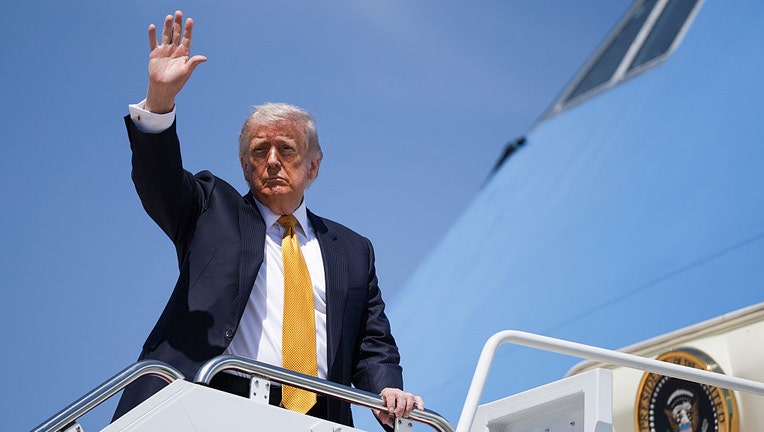
President Donald Trump waves as he boards Air Force One on May 12, 2026 at Joint Base Andrews, Maryland. (Photo by Alex Wong/Getty Images)
President Donald Trump departed Tuesday for Beijing for a highly anticipated summit with Chinese President Xi Jinping this week.
Trump and Xi are meeting in a two-day summit on May 14 and 15. Trump’s trip was initially delayed so he could help steward the U.S. and Israeli war against Iran. The United States and Israel launched the attacks against Iran on Feb. 28.
RELATED: US-China trade war reignites as both sides slap new tariffs
Xi and Trump’s meeting is shaping Beijing's approach to the Iran conflict even as the world's top crude oil importer, reliant on the Middle East for half its fuel, seeks to protect its energy supplies.
Despite Trump’s trip to China being planned for months, it started to unravel as he pressured Beijing and other world leaders to use their military force to protect the Strait of Hormuz.
Citing Chinese state media, Reuters noted that both the U.S. and China have expressed willingness to "promote the healthy, stable and sustainable development of China-U.S. economic and trade relations."
Why is Trump traveling to China?
What's next:
President Donald Trump’s visit to China is seen as a chance to fortify a delicate trade truce between the U.S. and China, but it has become complicated in Trump’s attempt to find a resolution to the war in Iran.
Reuters reported that the meeting between Trump and Chinese leader Xi Jinping will have a narrow focus, avoiding topics, including AI governance and market access.
RELATED: Trump threatens Canada with 100% tariffs over China trade deal: What we know
After pressing China and other nations to send warships to secure access to Middle Eastern oil, Trump indicated in March that his travel plans depended on Beijing’s response, though he explained at the time that the U.S. didn’t need help from the allies that rejected his request.
Reuters reported that the U.S. naval blockade of Iranian ports is a direct and growing threat. China has participated in diplomatic activity and refrained from strong criticism of Trump's conduct of the war so that the summit can happen.
In April, Xi addressed the Iran war with a four-point peace plan that called for upholding peaceful coexistence, national sovereignty, the international rule of law and balancing development and security.
CEOs and top executives joining Trump in China
Local perspective:
A White House official told Reuters that over a dozen CEOs and top executives are joining the U.S. delegation with President Donald Trump in China.
The companies include the following:
- Apple (Tim Cook)
- Blackrock (Larry Fink)
- Blackstone (Stephen Schwarzman)
- Boeing (Kelly Ortberg)
- Cargill (Brian Sikes)
- Citi (Jane Fraser)
- Cisco (Chuck Robbins)
- Coherent (Jim Anderson)
- GE Aerospace (H Lawrence Culp)
- Goldman Sachs (David Solomon)
- Illumina (Jacob Thaysen)
- Mastercard (Michael Miebach)
- Meta (Dina Powell McCormick)
- Micron (Sanjay Mehrotra)
- Qualcomm (Cristiano Amon)
- Tesla/SpaceX (Elon Musk)
- Visa (Ryan McInerney)
US sanctioned China ahead of summit
Dig deeper:
The Associated Press reported that Secretary of State Marco Rubio and Treasury Secretary Scott Bessent have recently called on China to use its influence to help reopen the Strait of Hormuz.
On May 8, the State Department announced it was sanctioning four entities, including three China-based firms, for furnishing sensitive satellite imagery that allows Iranian military strikes against U.S. forces in the Middle East.
Meanwhile, the Treasury Department moved to target Chinese oil refineries accused of buying oil from Tehran, and shippers of oil. According to the AP, the sanctions curtail organizations from the U.S. financial system and punish anyone who does business with them.
Beijing has called the sanctions "illegal unilateral pressure" and enacted a blocking statute that outlaws any Chinese entity from recognizing or complying with the sanctions.
China and the US want to avoid a return to a tariff war
Big picture view:
On May 11, President Donald Trump minimized differences with China over Iran and reinforced that Xi wants to see the Strait of Hormuz reopened. "He’d like to see it get done," Trump said of the Chinese leader.
The Associated Press reported that Xi also has plenty of reasons not to let differences over Iran impact other facets of the relationship.
China imports roughly half of its crude oil and nearly one-third of its natural gas from Middle Eastern countries impacted by the closure of the strait, the AP reported, referencing China’s General Administration of Customs.
In April, Trump threatened to enforce a 50% tariff on China after reports that Beijing was preparing to deliver a shipment of new air defense systems to Iran, but he later backed away from the threat.
The Source: Information for this story was provided by The Associated Press and Reuters. This story was reported from Washington, D.C.